Visiting the DMZ
Makeda and I concluded an amazing (and chilly!) week in Seoul, South Korea with an all-day tour of the Korean demilitarized zone (DMZ). This is a 2.5-mile-wide, 160-mile-long buffer zone that divides North and South Korea and roughly follows the 38th parallel. I highly recommend this extremely unique experience to anyone visiting Seoul.
A brief history of the division of Korea
In 1910, Japan formally colonized Korea and ruled until its surrender at the conclusion of World War II in 1945. Japan’s defeat allowed the Soviet Union to assume control of the north of Korea and the United States to do the same in the south, with both powers agreeing to a buffer zone at the somewhat arbitrary 38th parallel. This was intended to be a temporary division until a unified Korean government could be established. However, worsening relations between the US and the USSR at the onset of the Cold War prevented the formation of a single government. The Republic of Korea (south) and Democratic People’s Republic of Korea (north) were formed. In the spring of 1950 North Korea invaded South Korea and initiated the Korean War, which lasted until 1953 when an armistice agreement was signed. This armistice formally created the DMZ, and although this agreement ended the actual fighting, it was not a peace treaty. This means that to this day, the two countries are at war.
The tour
Makeda booked our tour through Klook, and it included a visit to the Gamaksan Suspension Bridge, Imjingak Park, Dora Observatory, and The Third Tunnel. We departed in a tour bus from Myeongdong Station in Seoul at 9 AM and returned around 5 PM. During the one and a half hour drive from Seoul to the suspension bridge, our enthusiastic and charismatic tour guide Julie regaled us with the history of Korea, the Korean War, and the DMZ itself. The journey was comfortable and educational, and before long we arrived at Gamaksan.
Gamaksan Suspension Bridge
This is an incredibly scenic 150 meter long suspension bridge not far from the DMZ. After a short ten minute hike up a ridge from the parking lot we were greeted with panoramic views of the gorge and a wobbly walk across the bridge itself.
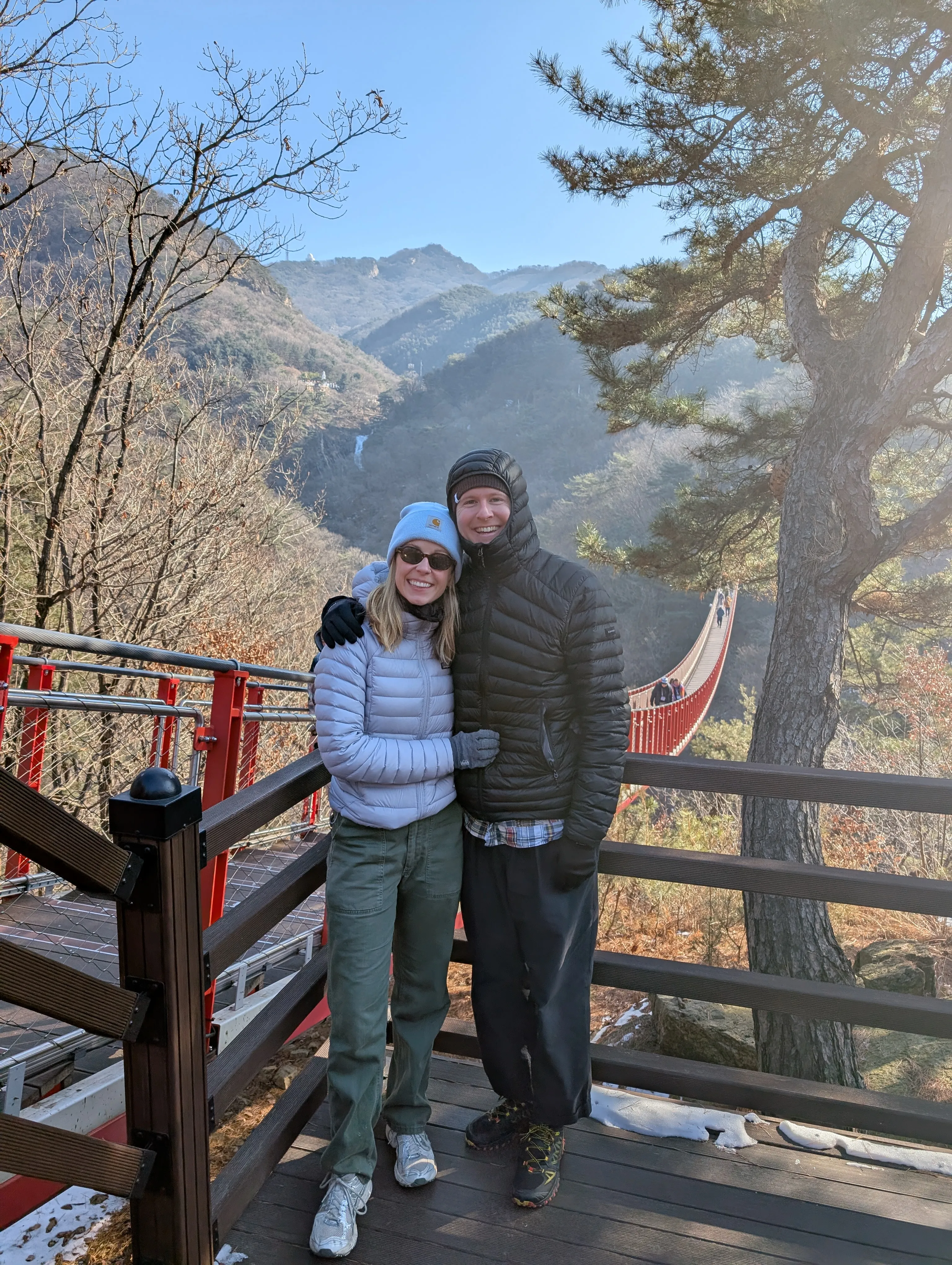 Makeda and I at the bridge.
There is a memorial here to the Gloucestershire Regiment that defended a strategic hill in the area during the Battle of the Imjin River in the Korean War. Upon returning to the parking lot we got our first glimpse of South Korean tanks.
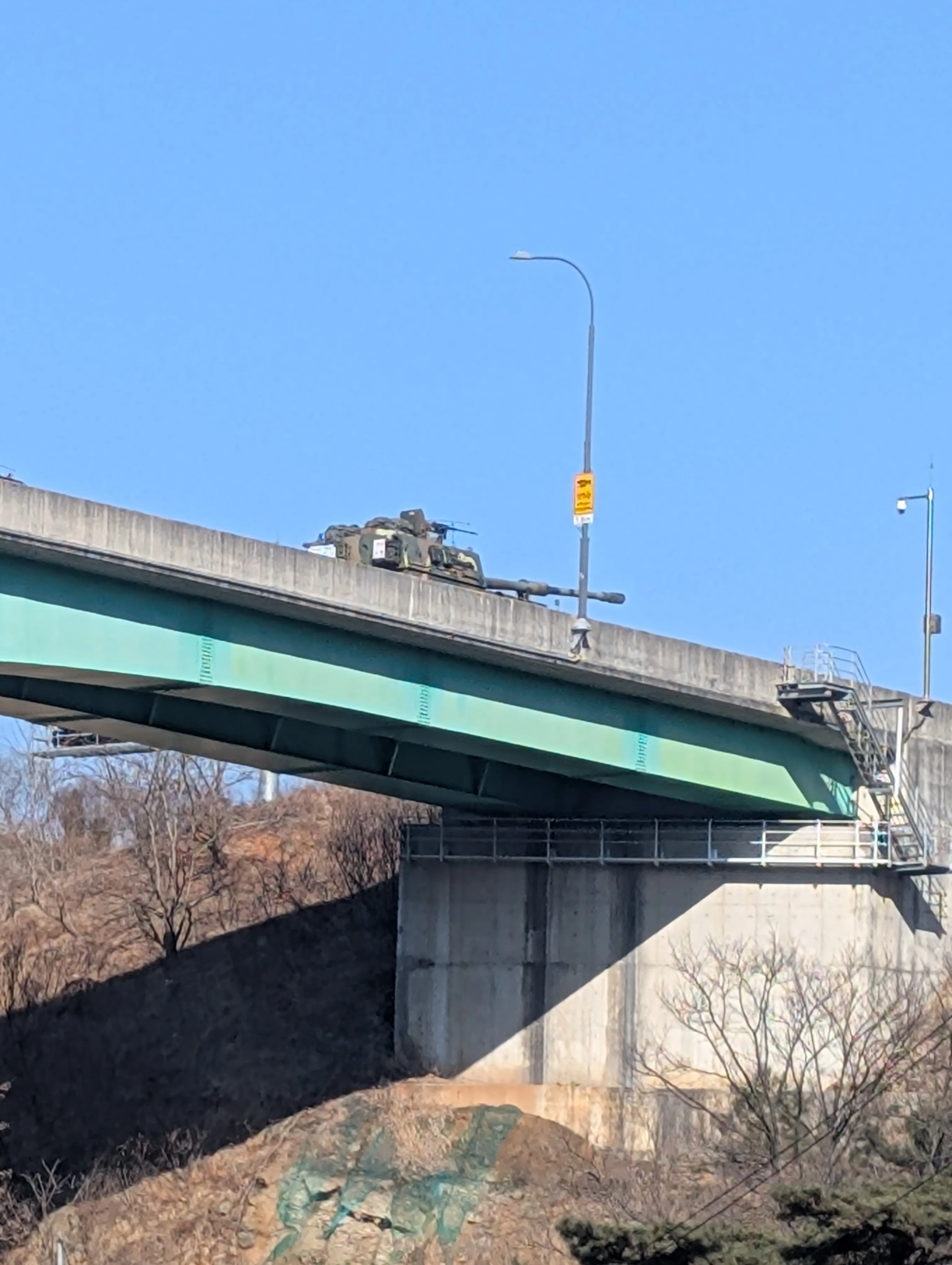 One of many South Korean tanks.
After piling back into the bus we departed for Imjingak Park.
Imjingak Park
Imjingak Park is a somewhat strange place. It is a place with monuments to the separation of Korean families and the Korean woman forced into sexual slavery under Japanese rule, alongside an amusement park with mini-rollercoasters and concessions.
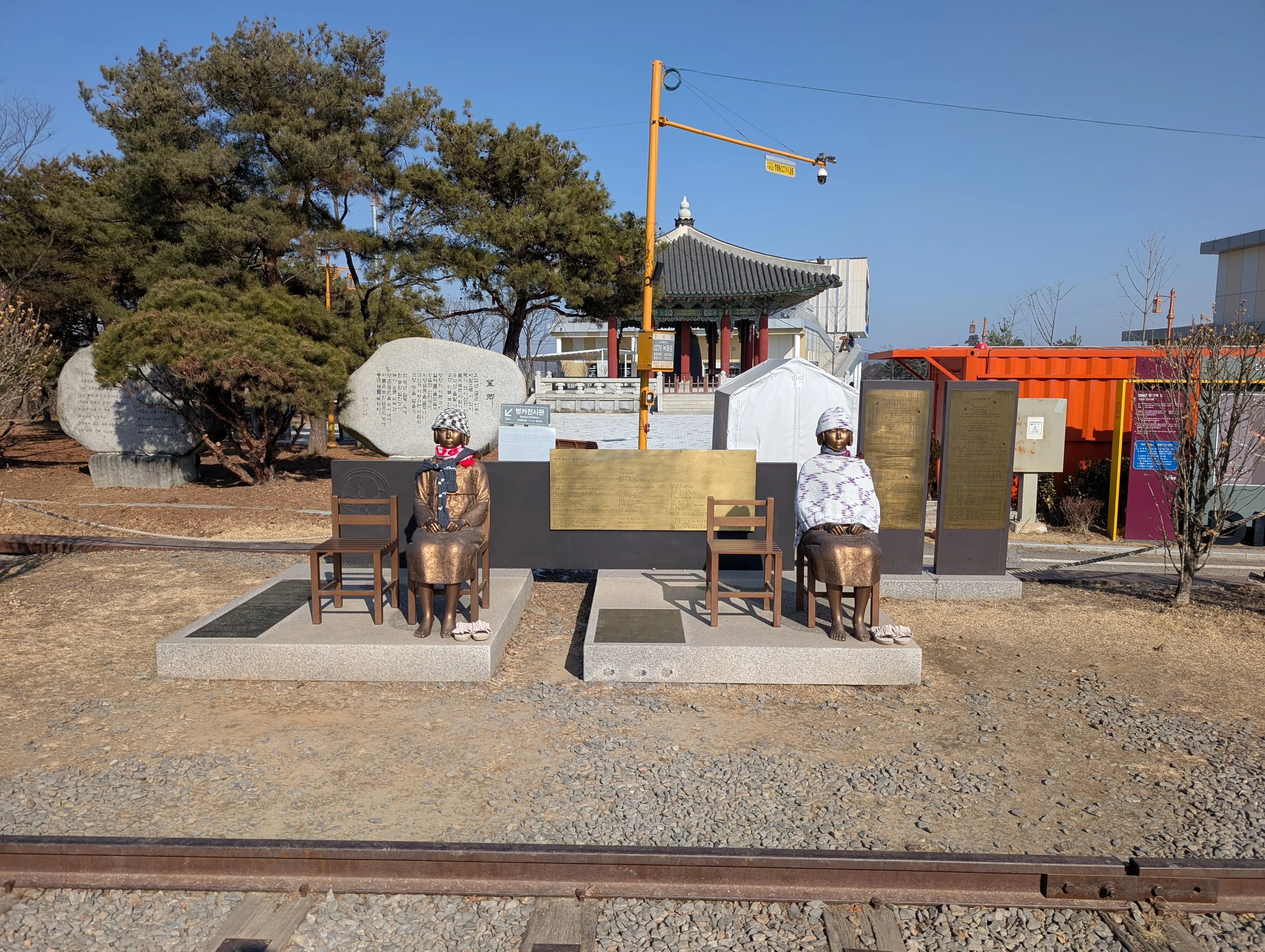 Monument to the women forced into sexual slavery during the occupation.
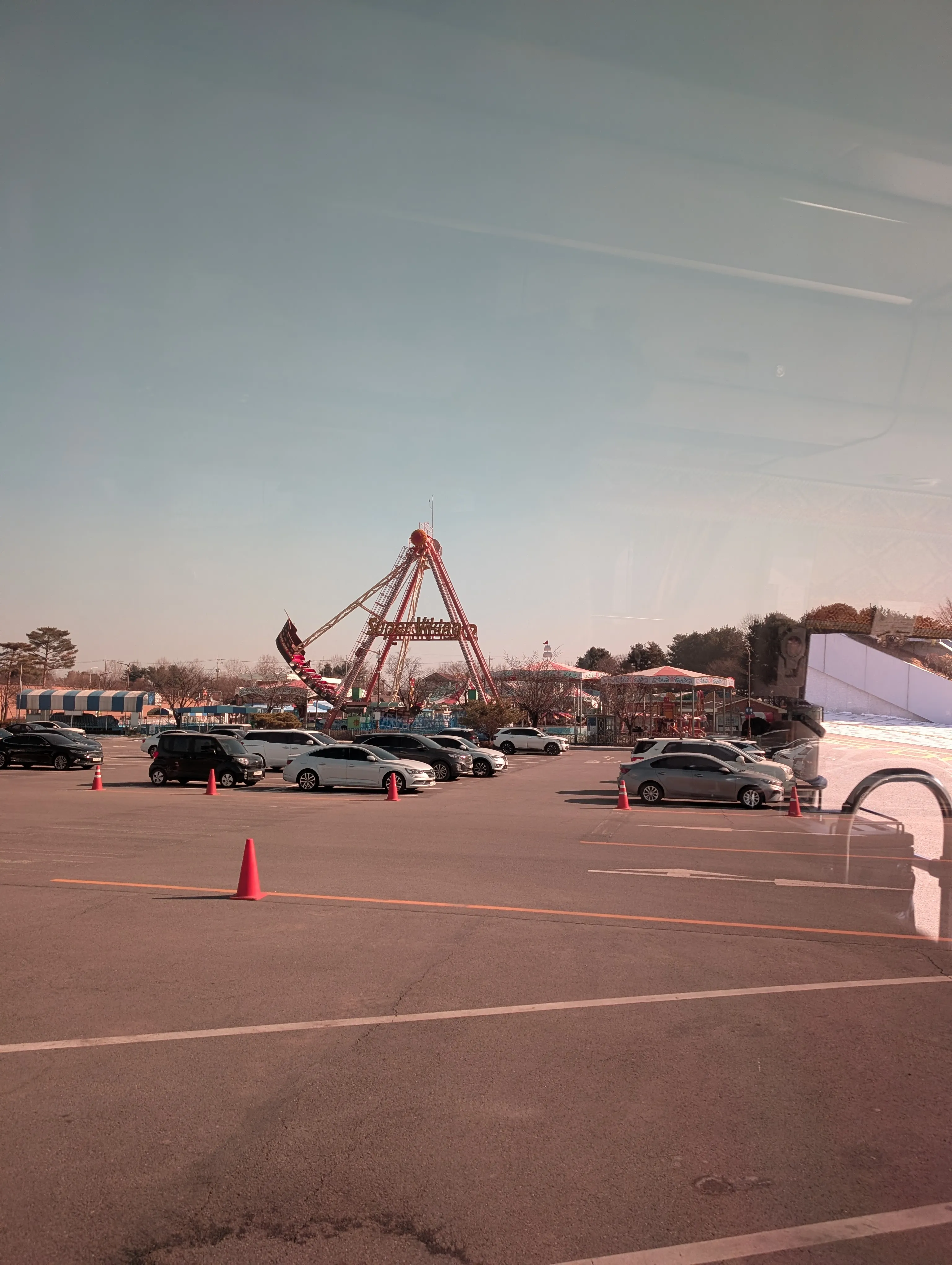 Theme park ride at Imjingak Park.
There is also a gondola that carries visitors over the nearby Imjin River. The park is designed as a monument to peace and unification, but I found the sharp contrast between such serious memorials and comparatively frivolous attractions to be jarring. Additionally, seeing a tilt-a-whirl less than a mile from sandbags, razor wire, and 15 foot fences did not exactly put me in the carefree theme park mindset. However, the park is intended to be a symbol of peace and hope for unification, so I can understand the attempt at levity in an otherwise incredibly serious area.
Dora Observatory
From Imjingak Park we finally entered into the actual DMZ. There are four main lines that comprise the DMZ. The CCL, SLL, MDL, and NLL. Assuming you are approaching from the south, the first line is the civilian control line (CCL). This is not literally within the DMZ, so it is still heavily fortified by the South Korean military with zig-zag road blocks, barbed wire, and tanks everywhere you look. As the name suggests, it is the northernmost point in South Korea that any person can travel independently. Beyond the CCL you either have to be on a tour or otherwise have privileged access. At this point a solider boarded our bus and checked everyone’s passport. After crossing the CCL, the next line is the southern limit line (SLL), which marks the southern border of the DMZ. The DMZ is of course demilitarized, so beyond the SLL you will no longer see any tanks, firearms, or trucks. There are military personnel, but they travel around in normal sedans.
The Dora Observatory sits atop a ridge and provides panoramic views of the remainder of the DMZ and North Korea beyond. Photos were strictly forbidden in the observatory. This was the highlight of the tour for me. Looking into such a uniquely authoritarian country (Amnesty International considers “North Korea to have no contemporary equal with respect to violations of liberty”) filled me with feelings of sadness, morbid curiosity, trepidation, and awe. I felt as if I were looking at something forbidden or dangerous, as if a DPRK soldier would pop up out of nowhere and arrest me, never to be seen again. From the observatory, we could see the dueling flags of the two nations, a massive GPS jamming tower in the distance, and myriad small buildings around the valley.
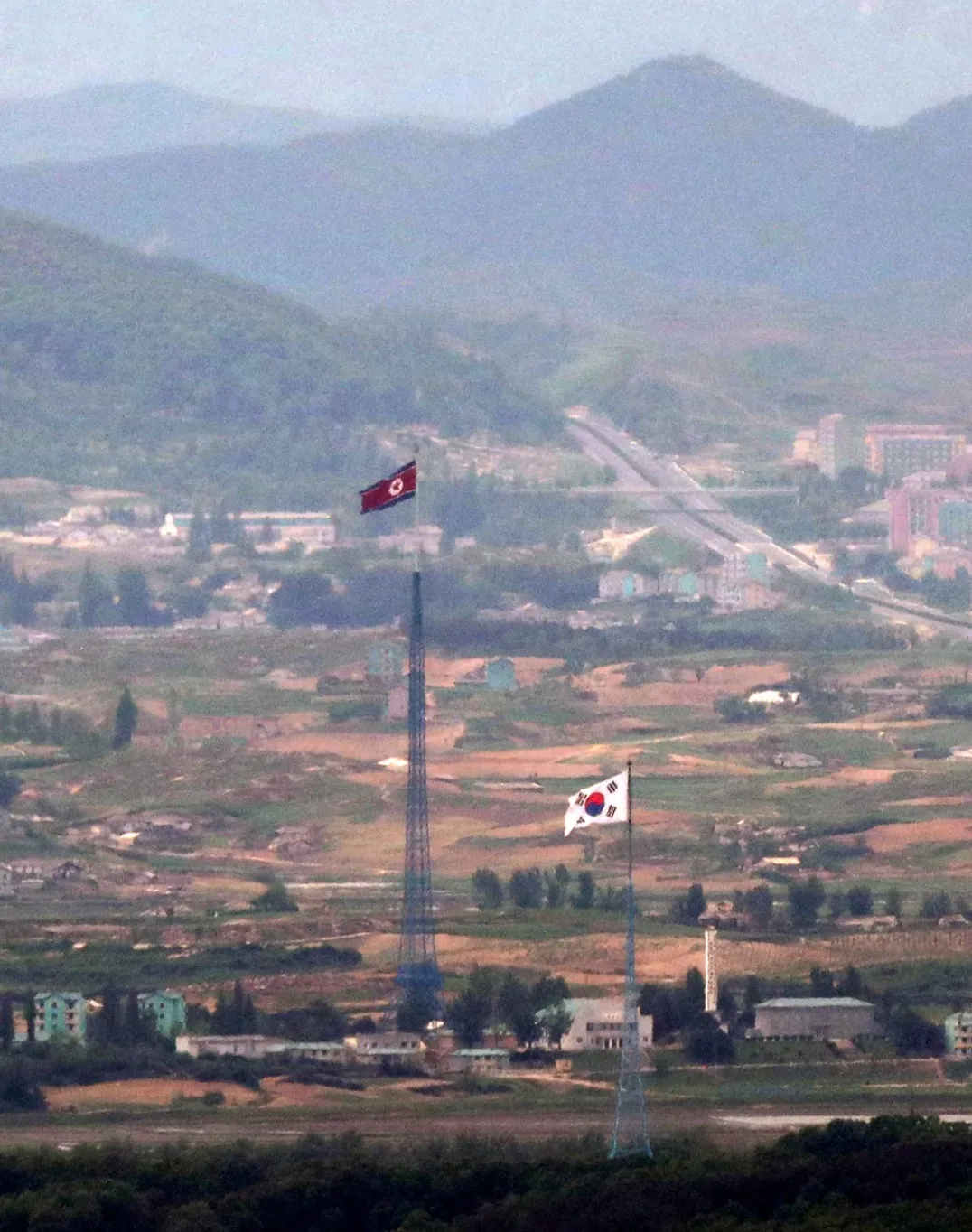 The dueling flags in the DMZ.
Using the provided binoculars, I painstakingly searched for any glimpse of people but was unsuccessful, which added to the eeriness of the situation. We learned that typically both sides of the DMZ blast Western music, white noise, the sound of babies crying, and other sounds to irritate each other, but in an attempt to improve relations the current South Korean president has turned off the speakers.
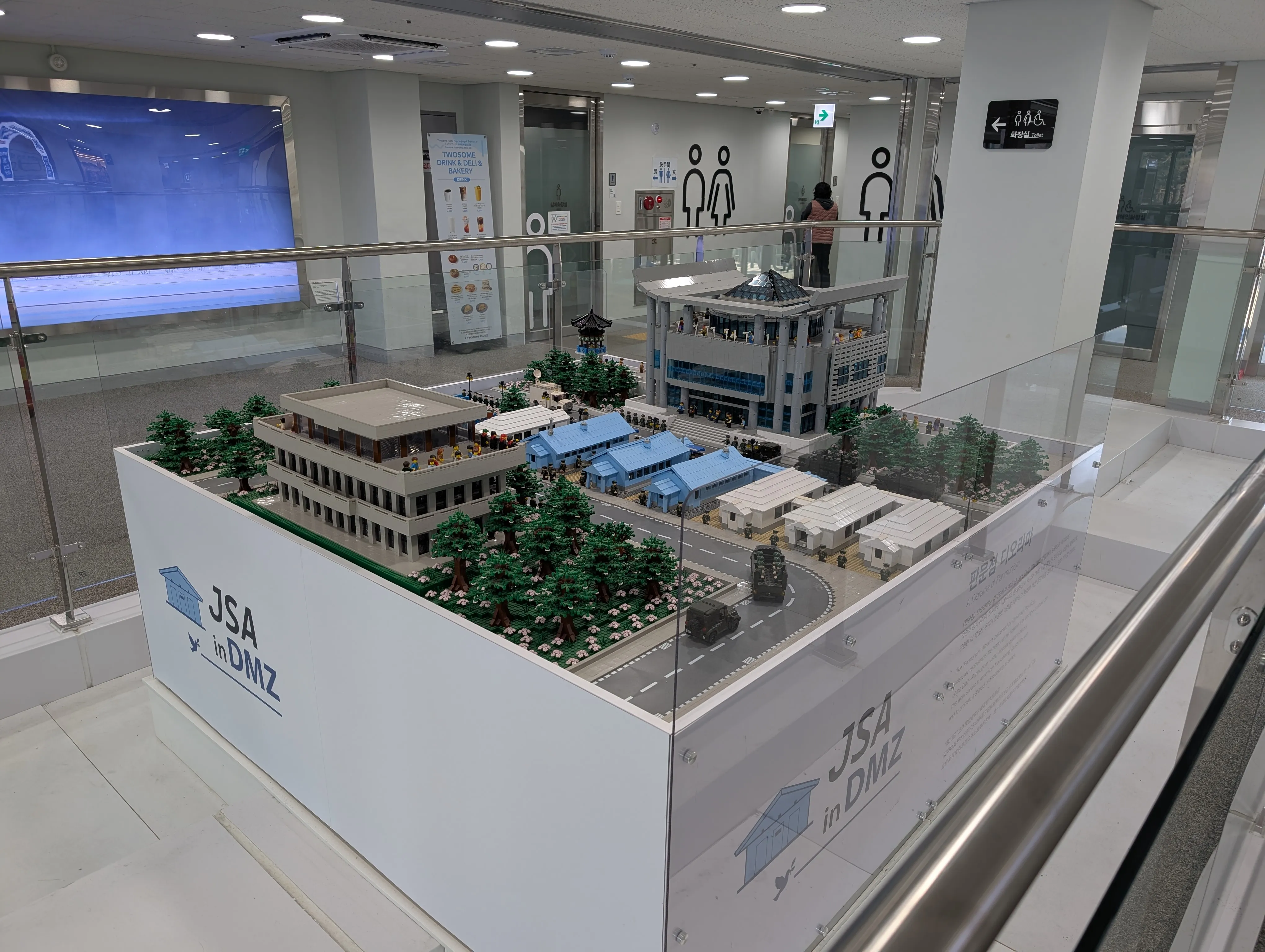 A LEGO model of the JSA.
From the observatory we were also able to see the Joint Security Area (JSA). This area straddles the military demarcation line (MDL), which is the formal border between the two countries and marks the center of the DMZ. This is the only connection point between the two countries and is the location of prisoner exchanges and diplomatic negotiations, including President Trump’s 2019 meeting with Kim Jong Un. The JSA features conference rooms that straddle the MDL, and during tours it is possible to technically cross the MDL into North Korea while in these rooms. Unfortunately, this area has been closed to tours since 2023 when former United States Army soldier named Travis King defected to North Korea while on a civilian tour of the JSA.
The Third Tunnel
Following the visit to the observatory, we traveled to our final stop on the tour: the Third Tunnel. In 1978 South Korea discovered four tunnels extending from North Korea under the DMZ, aided by one of the project leads defecting to South Korea. North Korea initially denied knowledge of the tunnels, only to claim later that they were coal mines. The tunnels have been sealed since their discovery, but the third tunnel is still open for tourists to explore. We were provided with hard hats and a warning from Julie that this part of the tour was the “D-M-gym.” This was aptly named, as the tunnel built to descend down and intercept the clandestine tunnel is quite steep and a quarter mile long. At the bottom we entered the actual tunnel which was 4 to 6 feet in height, meaning most people had to hunch over to pass through. It was a strange experience to voluntarily walk at least another quarter mile, hunched over, fighting claustrophobia, towards the most authoritarian country in the world. Eventually we reached the turn-around-point at the first blockade, which was fit with a small window allowing us to peer deeper into the tunnel. Needless to say, I was quite relieved to emerge out of the tunnel and straighten my back after the return journey.
Back to Seoul
After the Third Tunnel we got back in the bus, crossed back over the SLL, stopped for a brief lunch within the CCL (I had some tasty soybean soft serve), and then crossed back out and made our way back to Seoul. The entire experience was fascinating and surreal. In many ways it is bizarre to be able to visit one of the most heavily fortified border zones in the world, separating two countries literally at war with each other. Although there has not been any meaningful combat since the Korean War, it almost felt as if I looked too close, took a photo in the wrong place, or strayed too far from the tour that I might somehow reignite the conflict. Most military tourist attractions are commemorating battles long since finished, so it was strange to be in a place that simultaneously referenced a past war while preparing for a possible future one. Perhaps it is a similar experience as those who were able to visit Checkpoint Charlie before the Berlin Wall was torn down.
Overall, the experience has stuck with me long since leaving South Korea. It is truly a unique tour and absolutely a must-do if visiting Seoul. Makeda and I loved our guide, Julie, who made the trip fun and educational. Our only regret was not being able to visit the JSA. Don’t miss this!
MJ’s related media recommendations
- “Korea: A New History of South and North” by Victor Cha and Ramon Pacheco Pardo.
- Crash Landing On You (K-drama TV show in which a South Korean woman accidentally hang glides into North Korea and unexpectedly finds love).