Down the Mekong, Up the Nam Ou
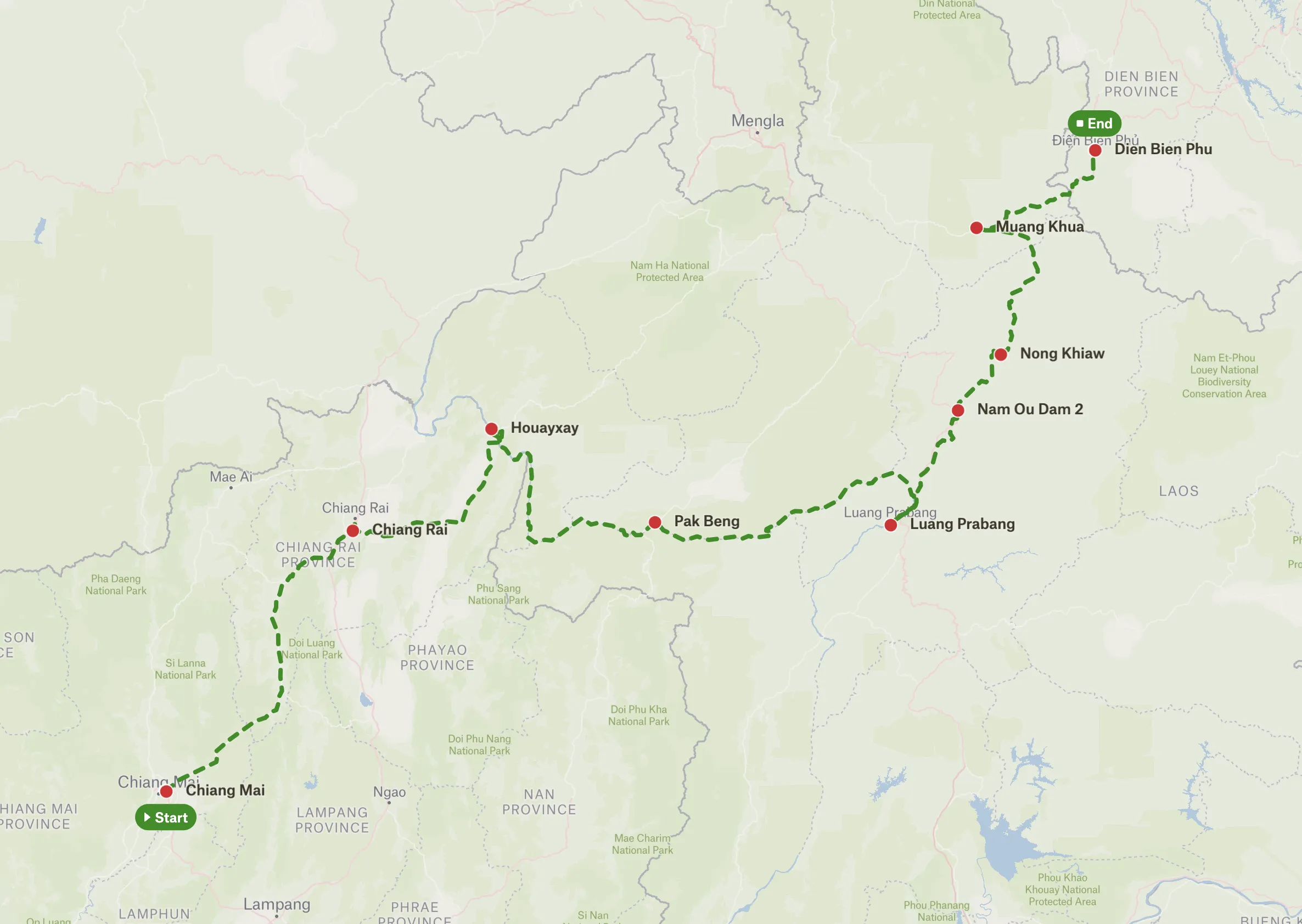
Over the course of two weeks, Makeda and I traveled overland from Chiang Mai, Thailand, to Điện Biên Phủ, Vietnam. The journey included boats, buses, scooters, pickup trucks and tuk-tuks. It took us across borders, down pristine river valleys, to the summits of jagged karst mountains, and through winding mountain passes. At every turn, we encountered friendly and helpful people, both locals and fellow travelers. The journey was an absolute highlight of our trip. What follows is a step-by-step account.
Chiang Mai to Chiang Rai, Thailand
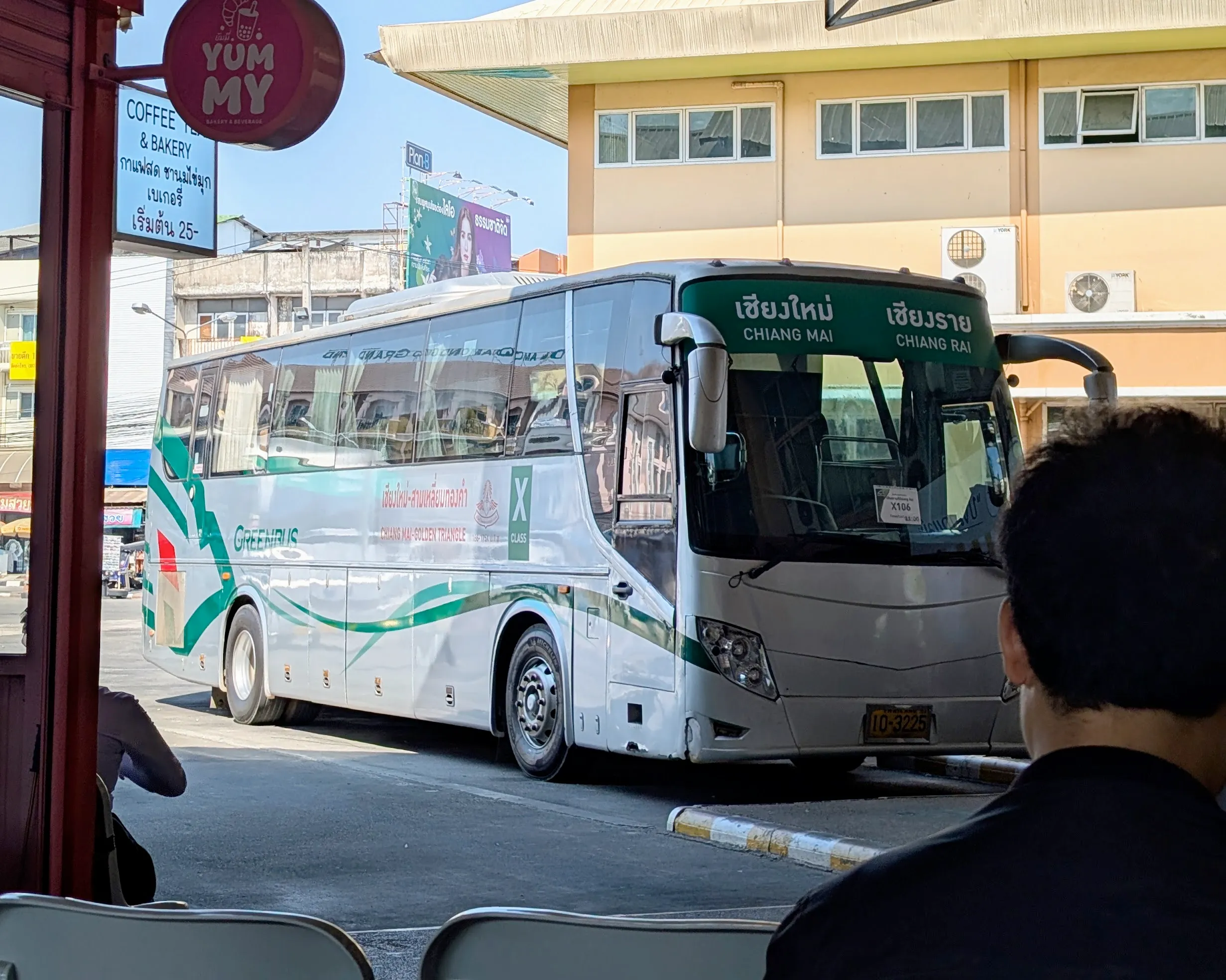 Our bus to Chiang Rai.
Our bus to Chiang Rai departed from the Chiang Mai Bus Terminal 3 at 11 a.m. and arrived in Chiang Rai a bit after 3 p.m. Our tickets cost 628 baht ($19.74) total and can be booked online. The bus was a typical tour-style coach that was definitely starting to show its age. The seats were neither comfy nor spacious, but hey - they were $10. The drive itself was easy overall; we had two quick rest stops, and the roads were largely well paved. A large freeway project is underway for part of the route, and in that section we took several unpaved detours. All in all, this is a cheap, straightforward journey.
Chiang Rai, Thailand
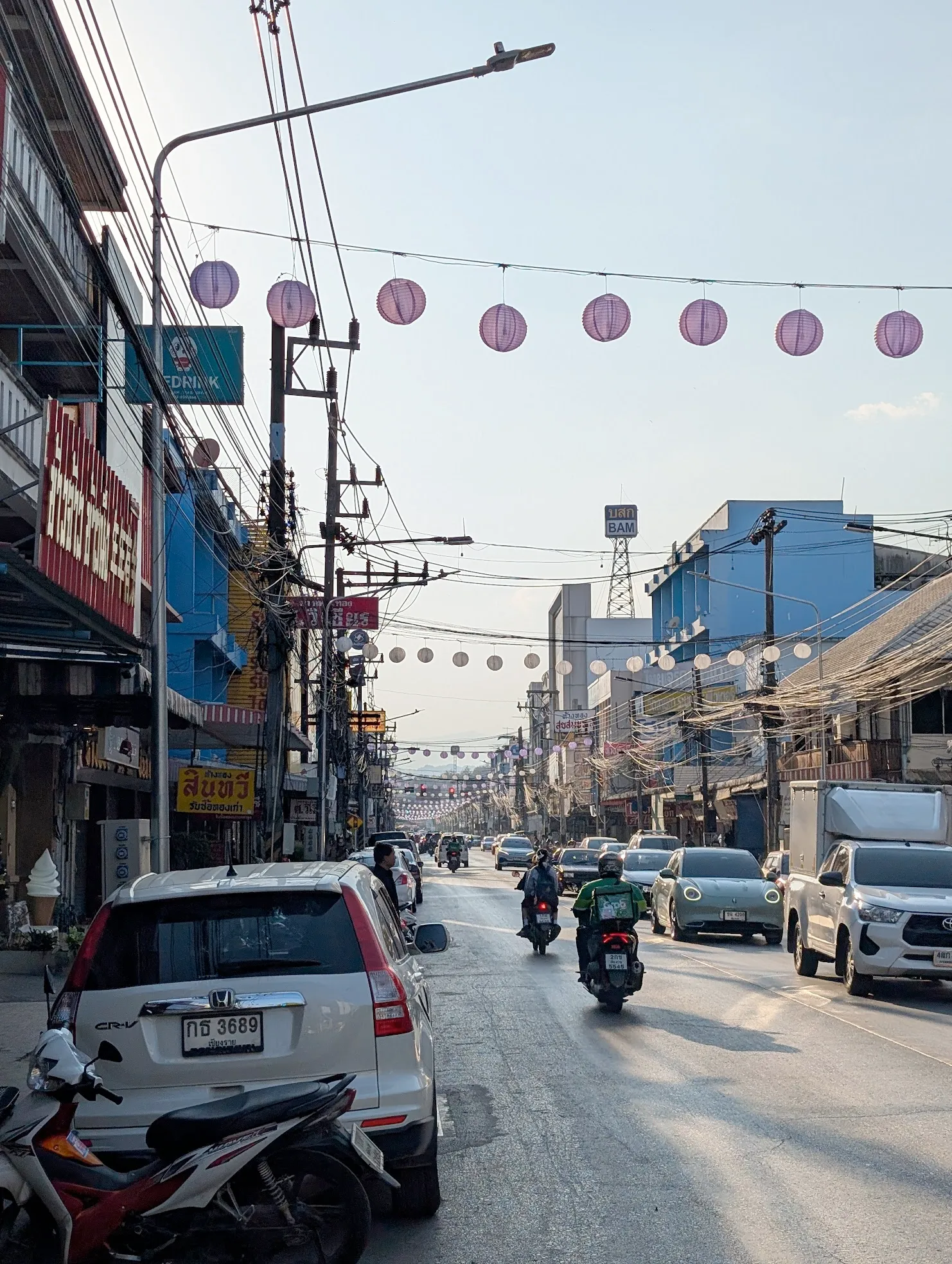 Chiang Rai in the late evening.
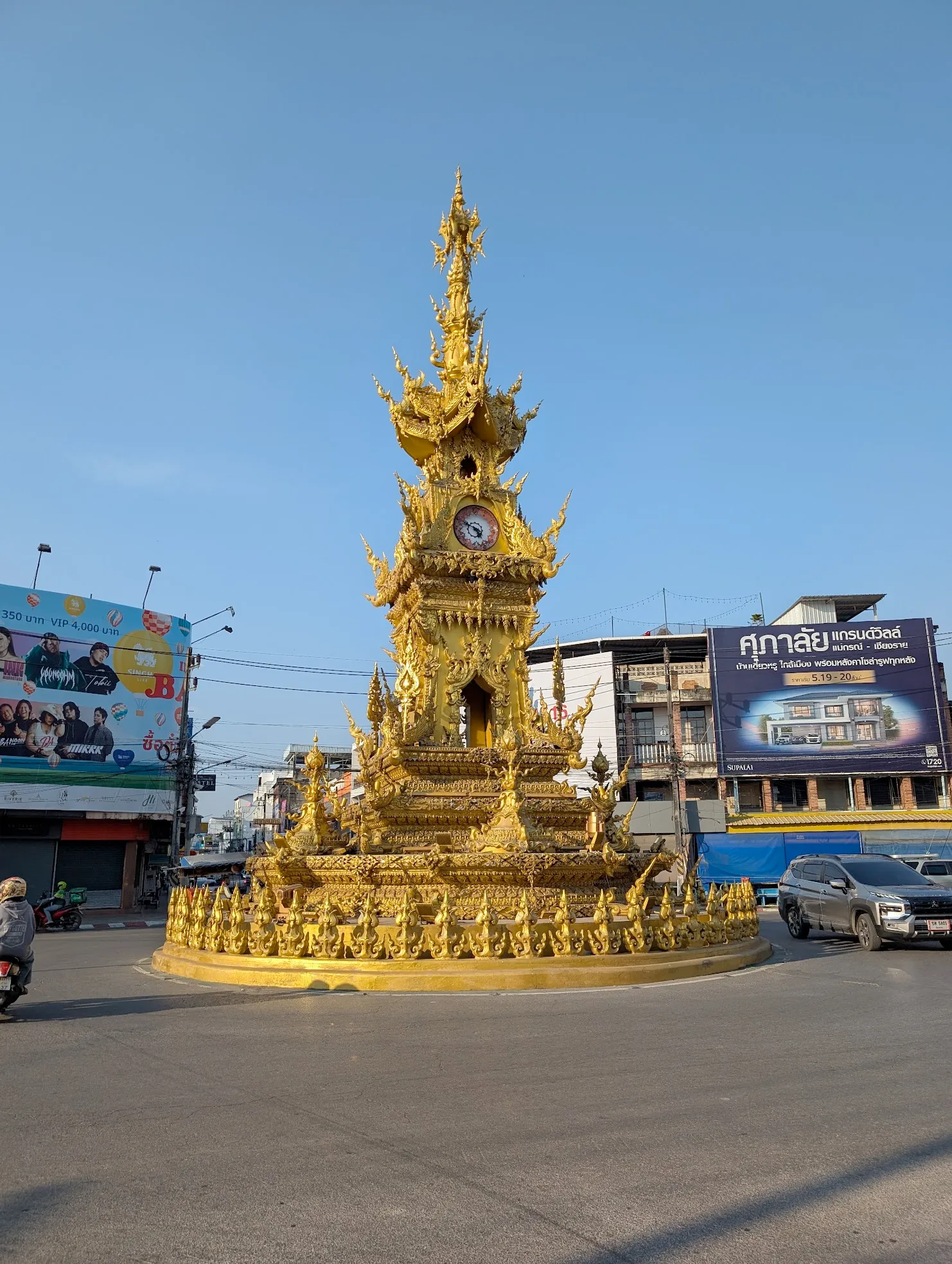 Chiang Rai Clock Tower.
We spent one night in Chiang Rai at a charming guesthouse a short walk south of the bus station. After some rest, we made our way into the city. Chiang Rai is a small but bustling place with a night market, temples and easy access to northern Thai destinations. The last time I had been here was in 2014, for a single night before a border run to Myanmar to extend my Thai visa. This time, Makeda and I enjoyed a Chang beer or two alongside some tasty sukiyaki before turning in for the night.
Chiang Rai, Thailand to Houayxay, Laos
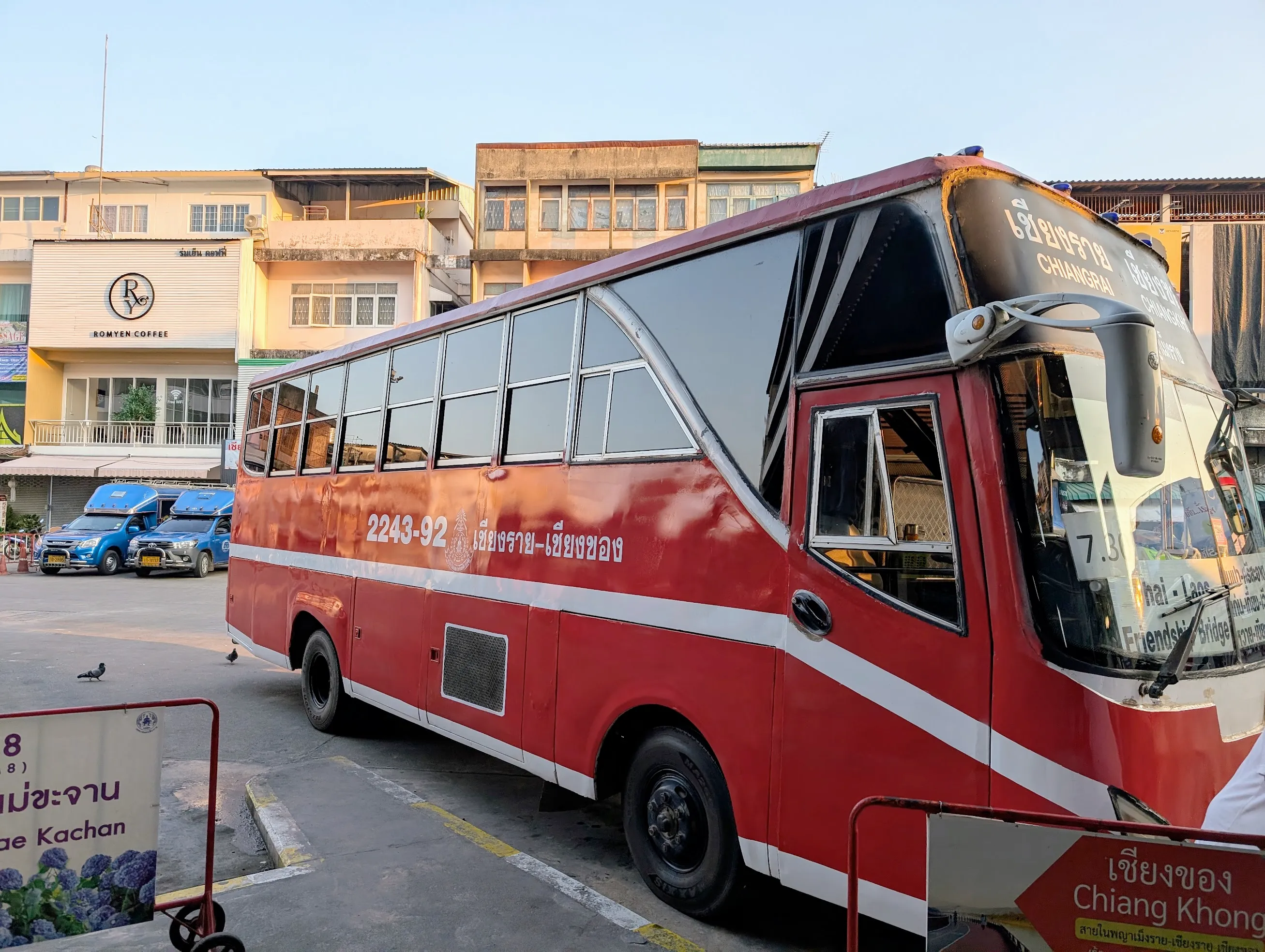 Our bus to the Thai border.
Our plan for this leg was to take the 6 a.m. bus to the border, cross into Laos, and catch the Slow Boat that we were pretty sure left around 10:30 or 11 a.m. However, this plan was based largely on snippets from blog posts and conversations with other travelers, not official timetables. So when we arrived at the bus station at 5:30 a.m. only to find that the 6 a.m. bus has apparently not been running since the pandemic, we knew we were just going to have to go with the flow. The next bus did not leave until 7:30 a.m., and with an advertised (wink, wink) travel time of two hours to the border, the chances of making the Slow Boat that day were slim. We grabbed some coffee and breakfast at the station; Makeda immediately befriended a cat, and I struck up a conversation with Andrej, a German traveler with whom we would end up traveling all the way to Luang Prabang. He had also planned for the 6 a.m. bus, but unlike Makeda and me, he had stayed up until 2 a.m. the previous night chatting with folks at his hostel. Nothing a coffee and a pack of cigarettes couldn’t fix, though.
Finally, 7:30 rolled around and we all piled into the big red bus that would take us to the border. We paid 280 baht ($8.80) total. This bus was somehow more comfortable than the bus from Chiang Mai, despite it being much older and the seats being schoolbus style benches. It is also a public bus and made several stops along the way. The journey to the Thai-Lao Friendship Bridge No.IV took just over two and a half hours. Along with Andrej, we naturally grouped up with an American named Ian and a Spaniard named Xinyi while crossing the border. The process was fairly simple: receive an exit stamp from Thai customs, take a 100-baht-per-person shuttle over the bridge into Laos, then apply for a visa on arrival at Lao customs. The Lao visa cost $40 per person, with an additional $1 if you did not have a printed passport photo; there was also a $2 service fee, which appeared to be at the discretion of the border officer on duty.
By the time this was all said and done, our hopes of making the boat that day were effectively squashed.
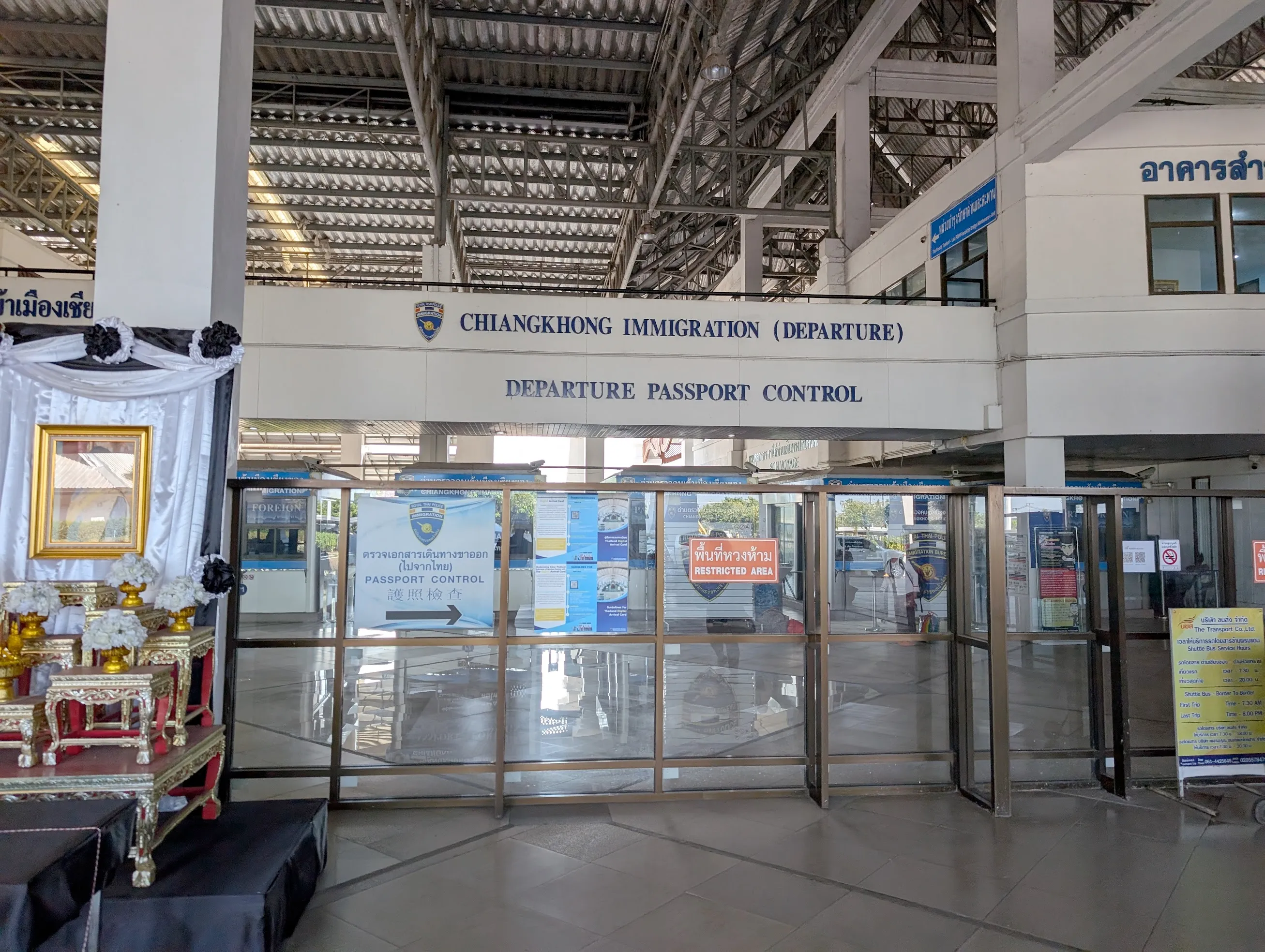 The border crossing at Chiang Khong.
The five of us split a 15-minute van ride from the bridge to the Slow Boat pier in Houayxay where we were indeed informed that the boat had already left for the day. Somewhat uncharacteristically, Makeda and I had already booked our future lodging in Pak Beng, Luang Prabang, and Nong Khiaw, so missing the boat was a genuine setback. The only same-day alternative was a prohibitively expensive speedboat, and our three new companions had no onward bookings and planned to stay the night in Houayxay anyway. So we sent change requests to our lodgings, booked a guesthouse, withdrew a few million kip and settled in for our first Beerlao. C’est la vie.
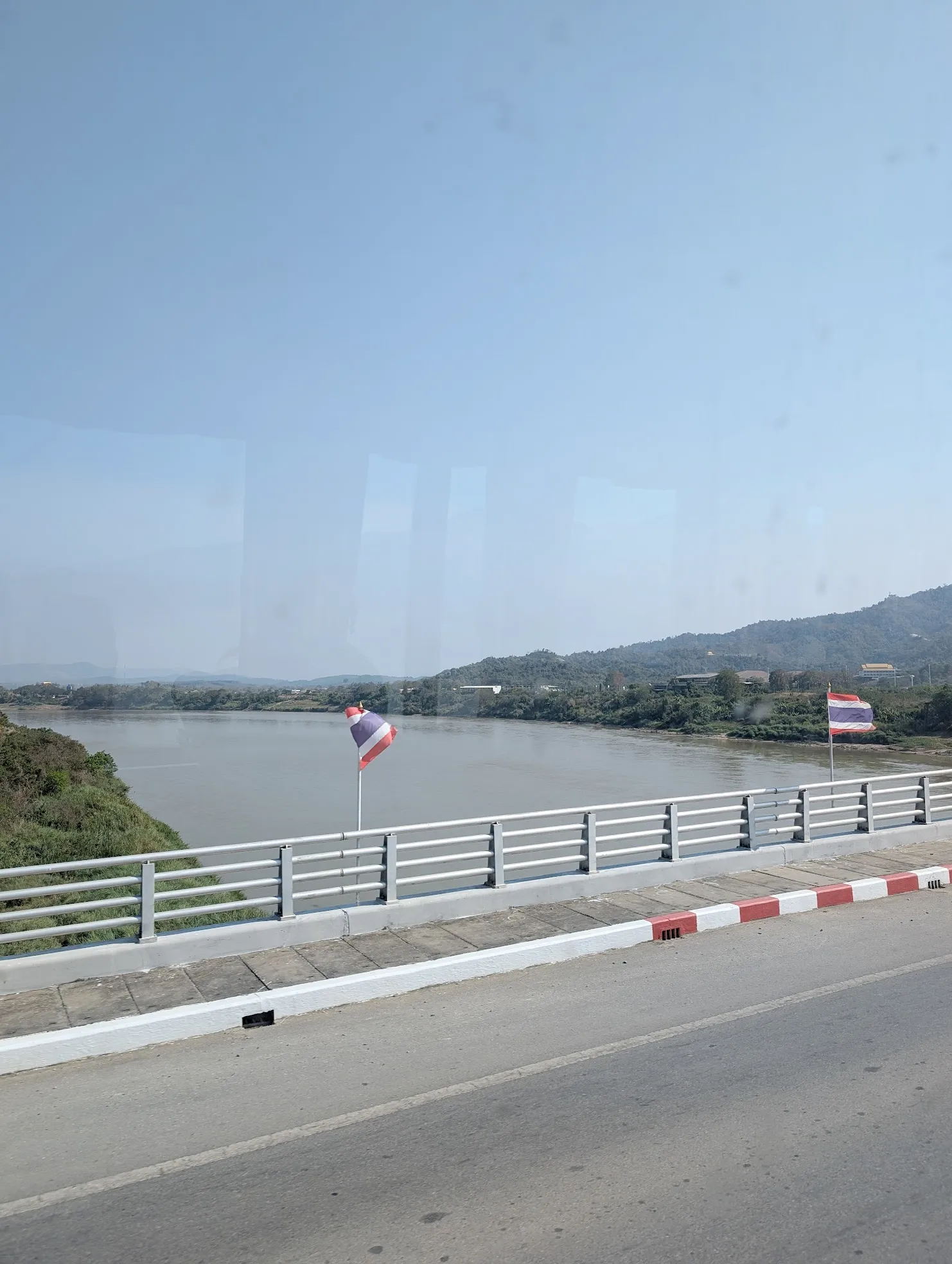 Thai-Laos Friendship Bridge No.IV.
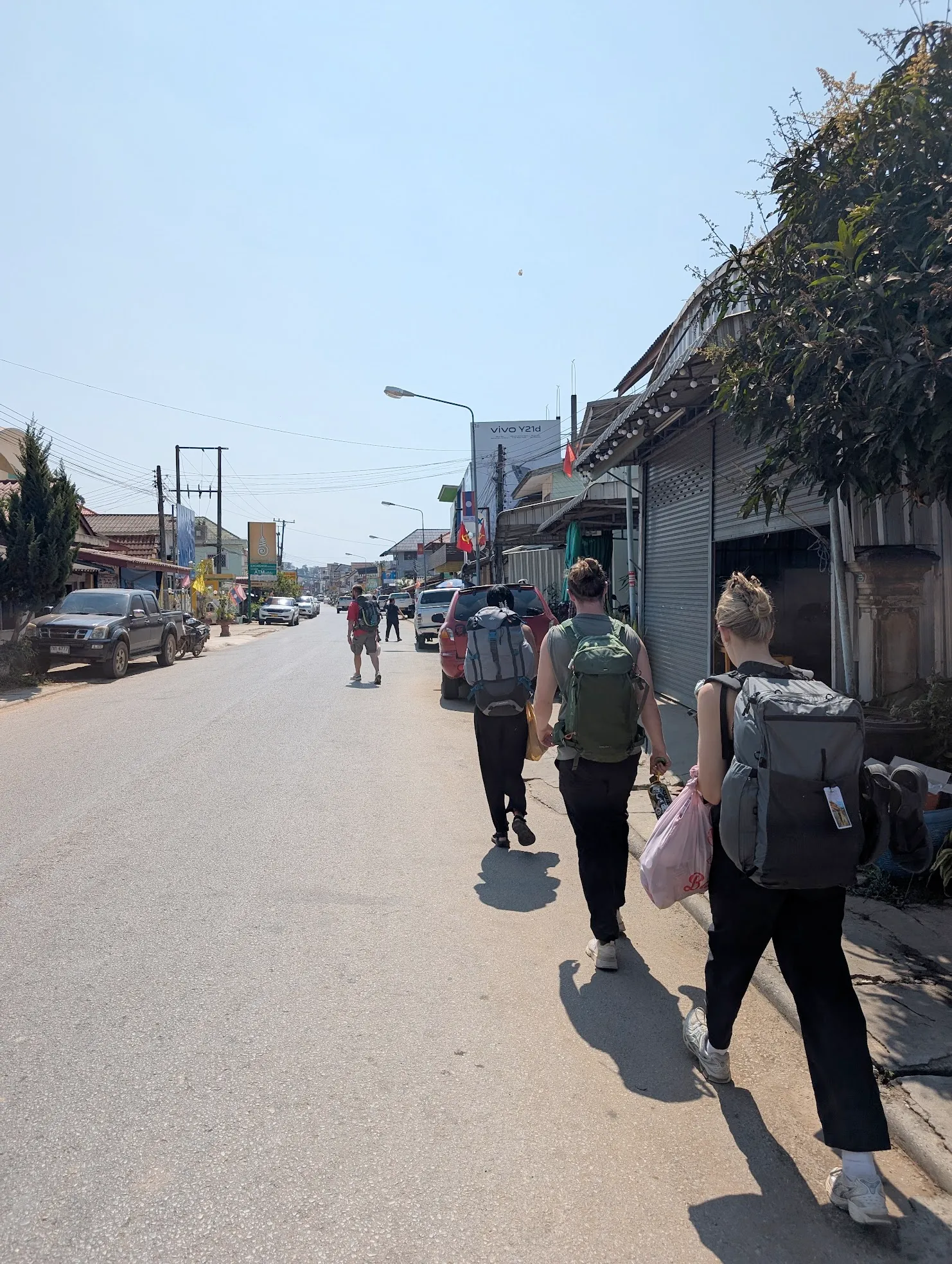 The crew in Houayxay.
In hindsight, I would recommend anyone planning to take the Slow Boat to plan for a night in Houayxay. Even if the 6 a.m. bus from Chiang Rai was running and we had caught the boat, it would have meant that we were likely getting the “worst” seats near the boat engine, as well as committing to a 6-7 hour journey after an early wake-up, bus ride, and border crossing. A night in Houayxay is $10 and you will be grateful for a bed and meal before the boat.
Houayxay, Laos
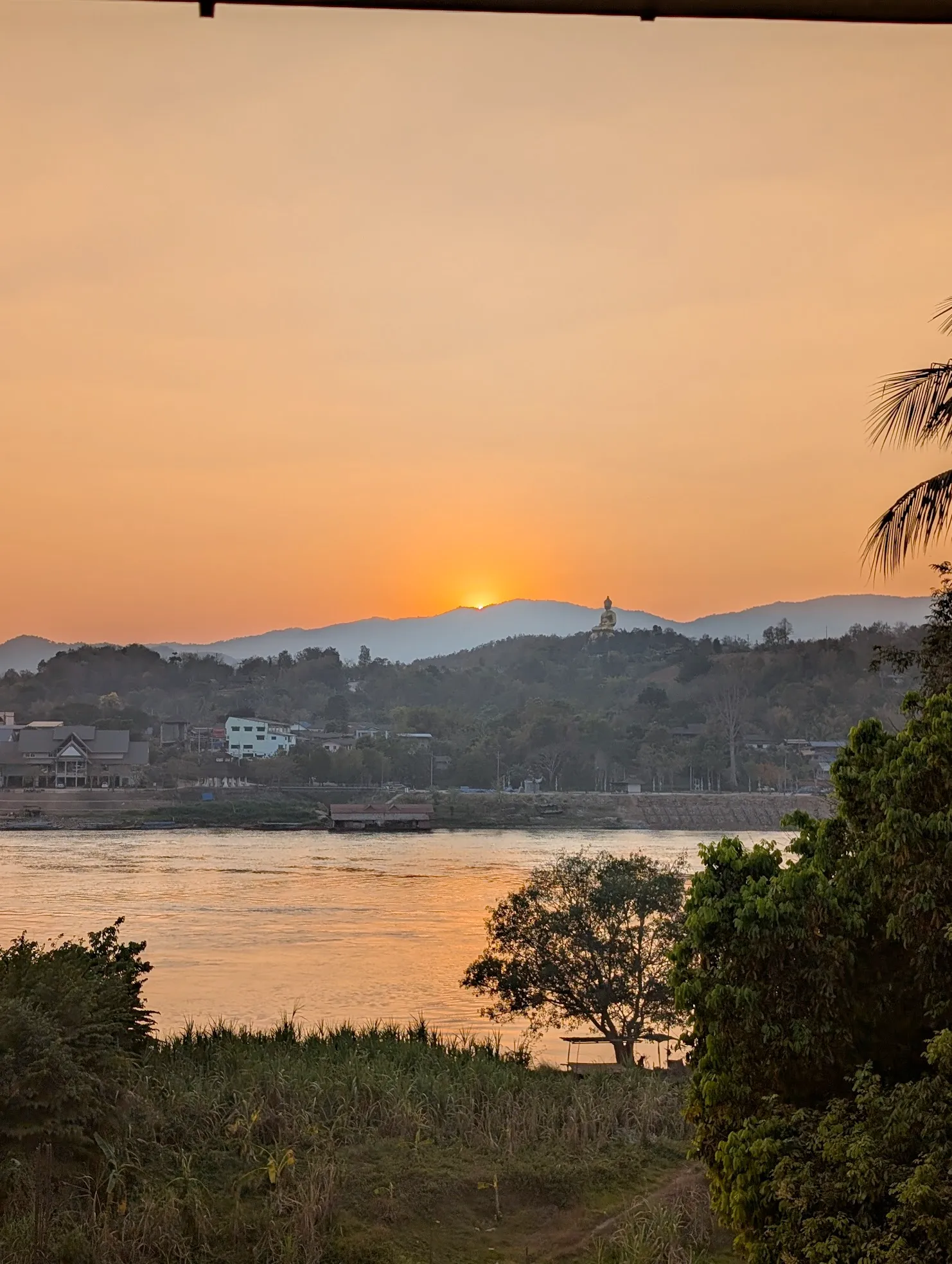 Sunset over the Mekong in Houayxay.
Houayxay is a small border town on the Mekong River opposite Chiang Khong, Thailand. There is a small domestic airport and is the home of the Gibbon experience. Primarily, it is start of southbound boat journeys, including the Slow Boat to Luang Prabang.
Makeda and I stayed in a comfortable and very affordable private room in a guesthouse overlooking the Mekong. We enjoyed the late afteroon and sunset on the communal balcony with our new friends, playing cards, chatting, and relaxing. A Belgian woman named Elina joined us on the balcony; she was one of the people Andrej had stayed up late chatting with the night prior in Chiang Rai. After a rooftop dinner with the crew, MJ and I turned in for the night.
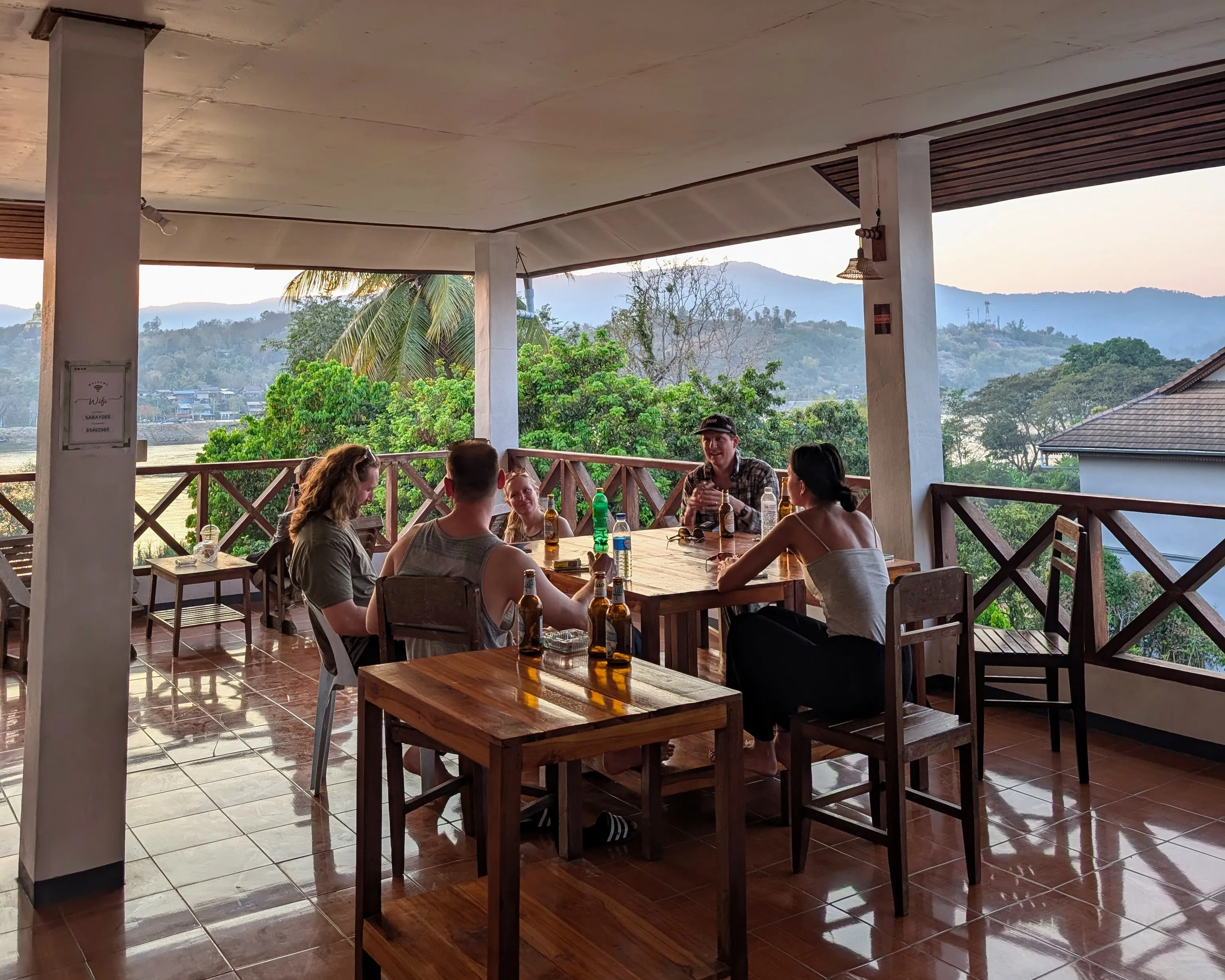 Cards on the balcony.
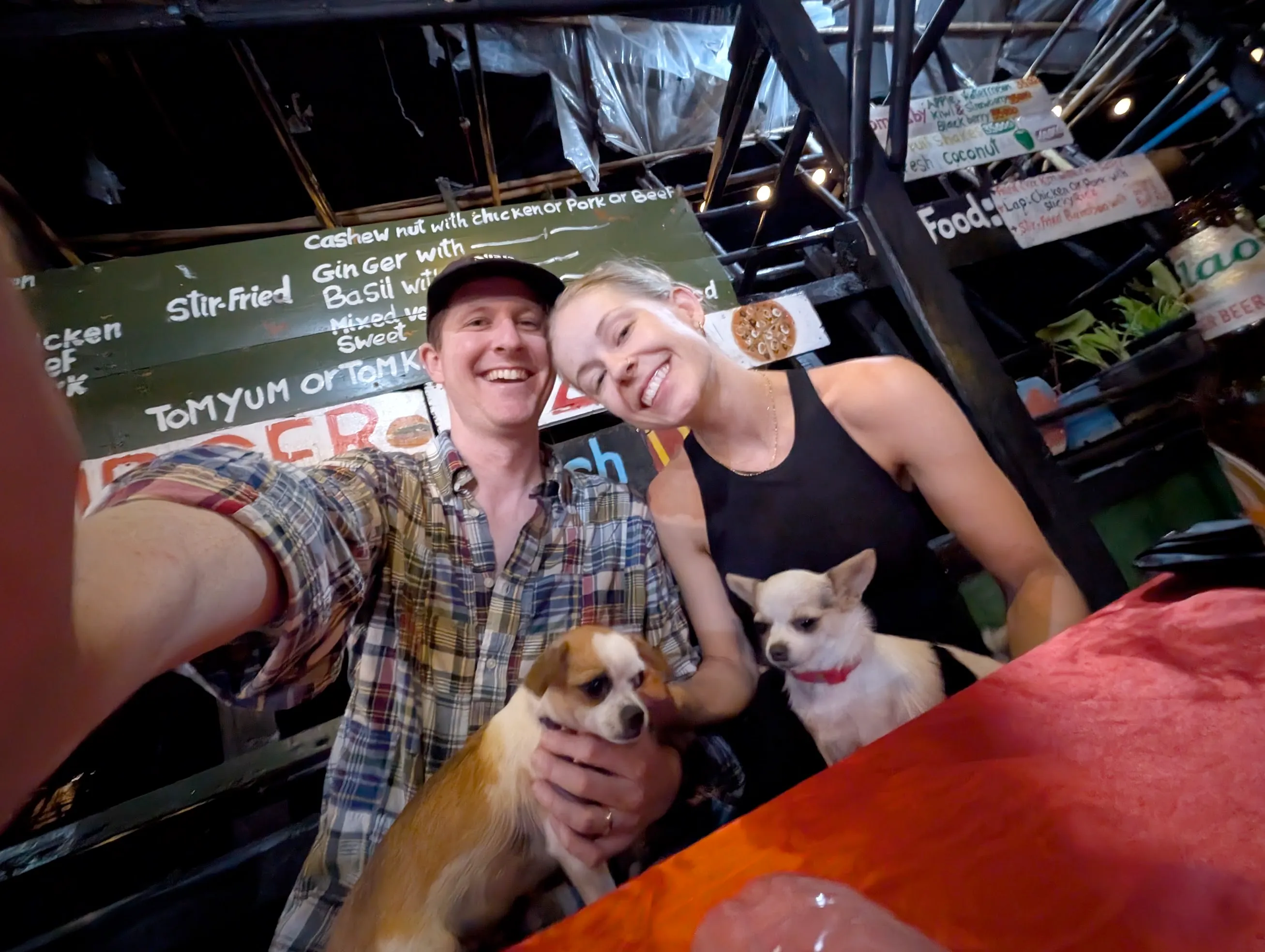 More new friends at dinner in Houayxay.
Slow Boat, Day 1 (Houayxay to Pak Beng)
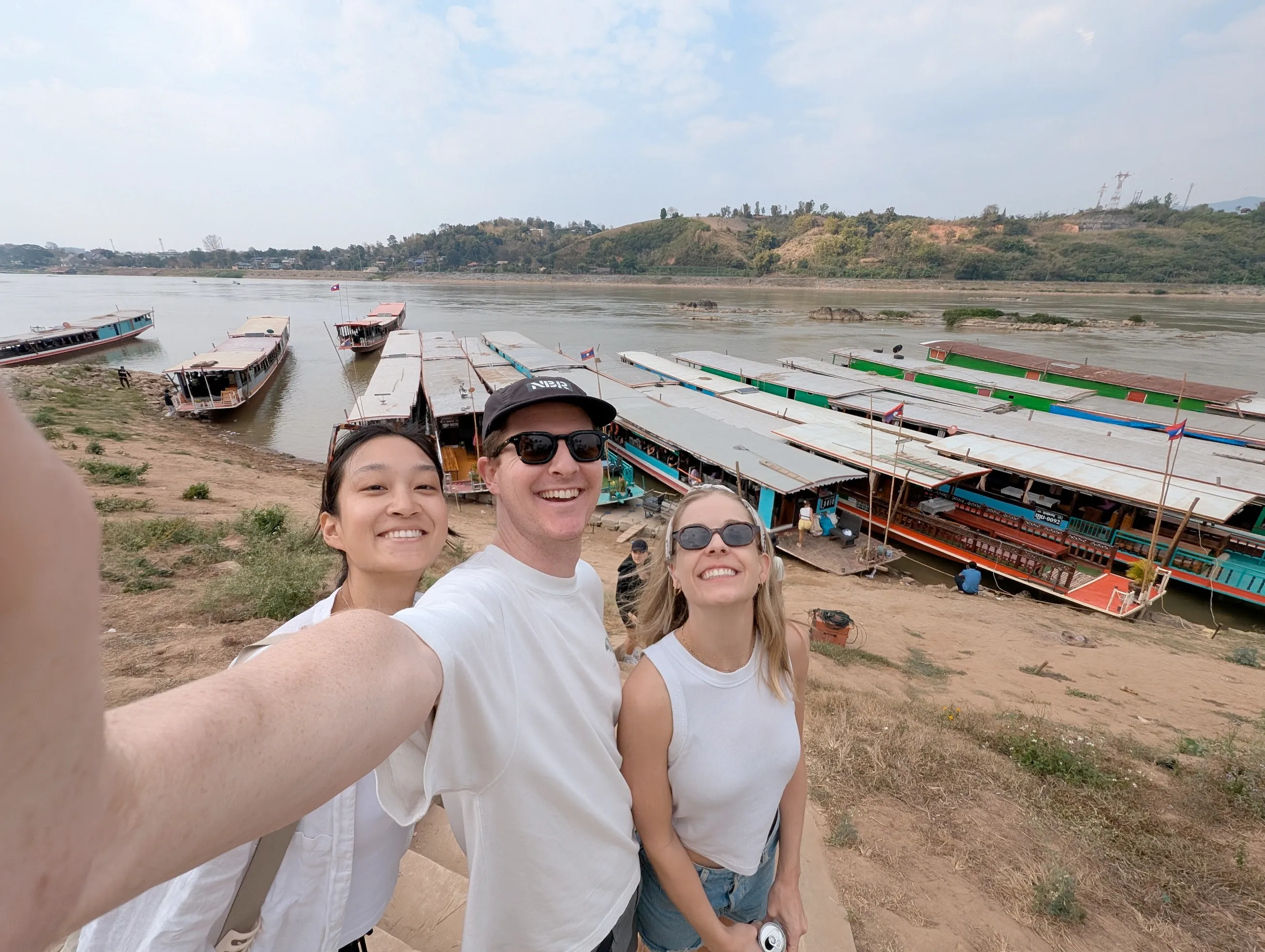 Makeda, Xinyi, and I before boarding the Slow Boat.
The Slow Boat is self-explanatory: it is a boat that slowly travels down the Mekong river to Luang Prabang over two days. The boat is long and narrow and fits around 100 passengers. Here are some logistical details about the journey:
- The tickets cost 400,000 kip ($18.68) per person when purchased at the pier ticket booth, covering both days. Our guesthouse offered tickets for 450,000 kip that included a tuk-tuk to the pier in the morning. Ian and Xinyi paid in Thai baht and spent the equivalent of about $8 more than those who paid in kip.
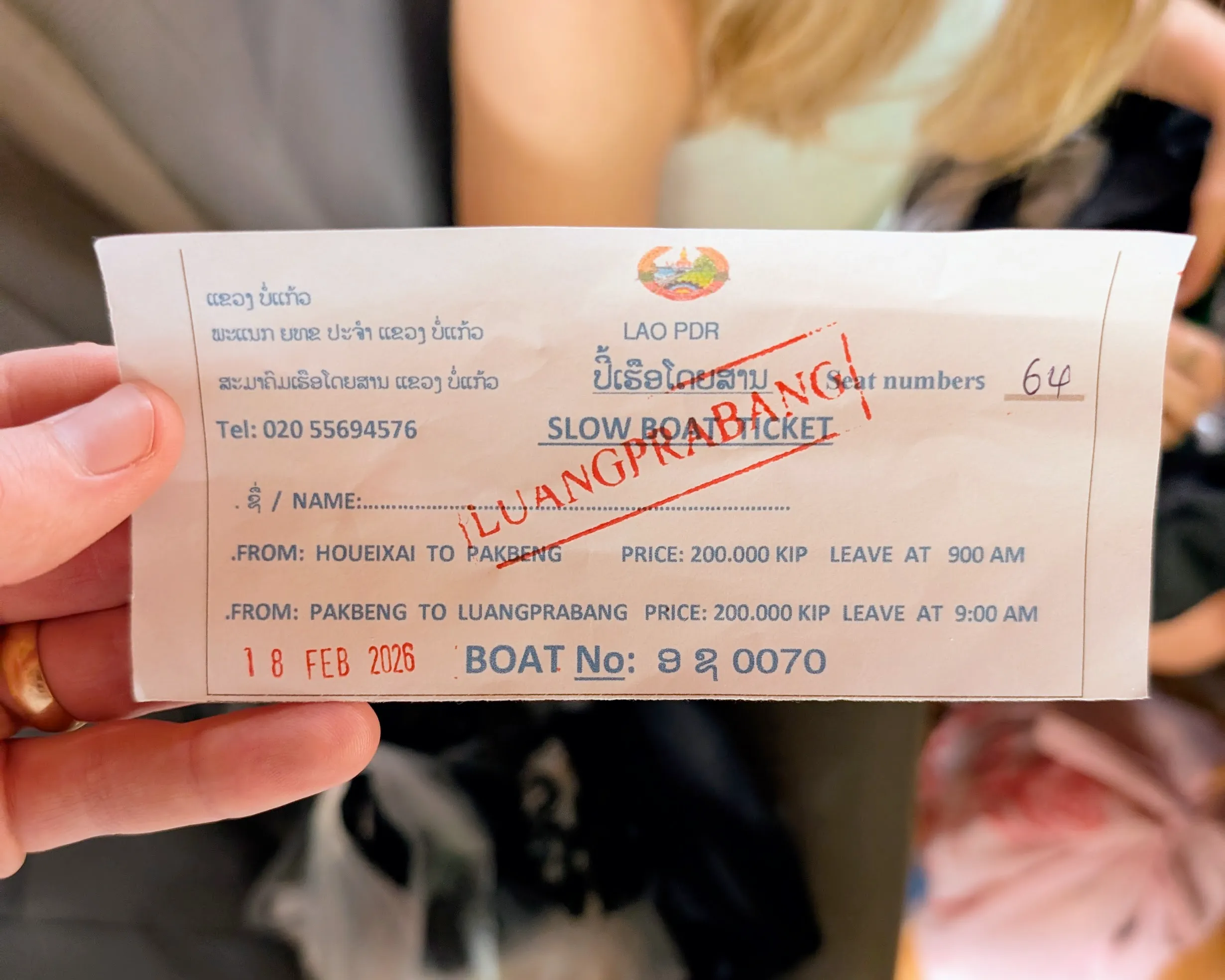 My ticket for the Slow Boat.
-
The order in which tickets are purchased determines your seat for the first day’s journey. The first person to buy a ticket gets seat number 1, then seat 2, etc. Generally speaking, the seats closer to the front are better, as they are further from the noisy engine in the back. The smoking section is at the stern, behind the engine room. You can buy your tickets the day before you plan to take the boat, which will likely mean a better seat.
-
As far as we could tell, there is only one departure per day at 9 a.m. We read on a few blogs that there are 1 to 3 staggered departures per day, but this was contrary to our experience.
-
Beer, sodas, water, and snacks are available for purchase on the boat. Alternatively, shops near the pier sell styrofoam coolers and ice if you prefer to curate your own refreshments. We ended up utilizing both options.
-
Luggage is stored either underneath the floorboards or in the back above the engine. Either way, I recommend having a separate bag with everything you might need during the journey.
-
There are other, slightly-less-Slow Boats that cost more and appear to be more comfortable. The boat is the same but there are fewer passenger and more space. We don’t regret taking the cheaper boat at all, but I’m sure others did.
In my opinion, the Slow Boat is the epitome of journey over destination. You have to do it for the love of the game. You are trading time for money and comfort for experience. And the quality of the experience, like many things while traveling, is basically up to your expectations, attitude, openness, and of course, luck. Makeda and I were lucky enough to start the journey with five other people we liked, but there is no shortage of camaraderie to be found on the journey. The first day on the boat felt like a microcosm of my freshman year of college: a group of mostly strangers sharing a novel experience with an unspoken openness to interaction and a broad willingness to swap knowledge, support, and resources. And of course, drinking most of the time.
On our boat there was a small army of 20-something Brits with a ration of 6-8 big Beerlaos a head; an Aussie family of six on a sabbatical trip around the world (whose youngest son was an absolute terror who thankfully decided to focus his harrassment on the Brits); a stalwart platoon of smokers who colonized the stern; a Canadian man named Kim from far northern Saskatchewan (eh?) with whom I had a long and mutally cathartic political conversation; two young women and a man whom we dubbed The Throuple; an almost cliché American woman who had just graduated college: friendly, outgoing, constantly flirting with the Brits, playing ukulele, and sporting the biggest Thai tattoo (road rash from crashing a scooter) we had ever seen; a Canadian woman who assured us she loved telling people she was not American; an American expat living in Australia; the nicest highschool sweethearts from the Netherlands; and many others. We passed the time playing cards, reading, chatting, and enjoying the view as water buffalo and forested mountains slipped by. Six hours later, we arrived in Pak Beng.
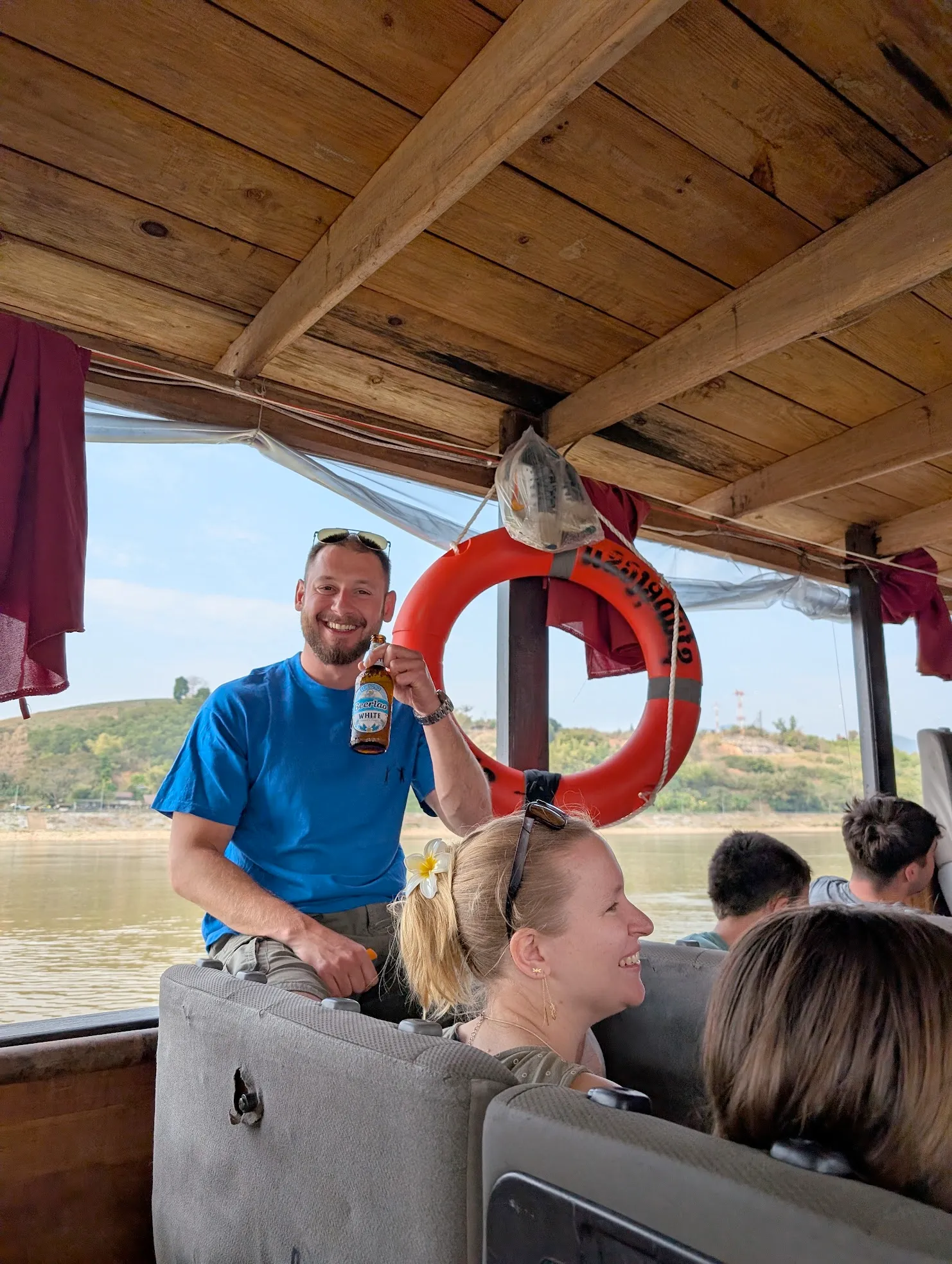 Andrej and Elina enjoying the boat.
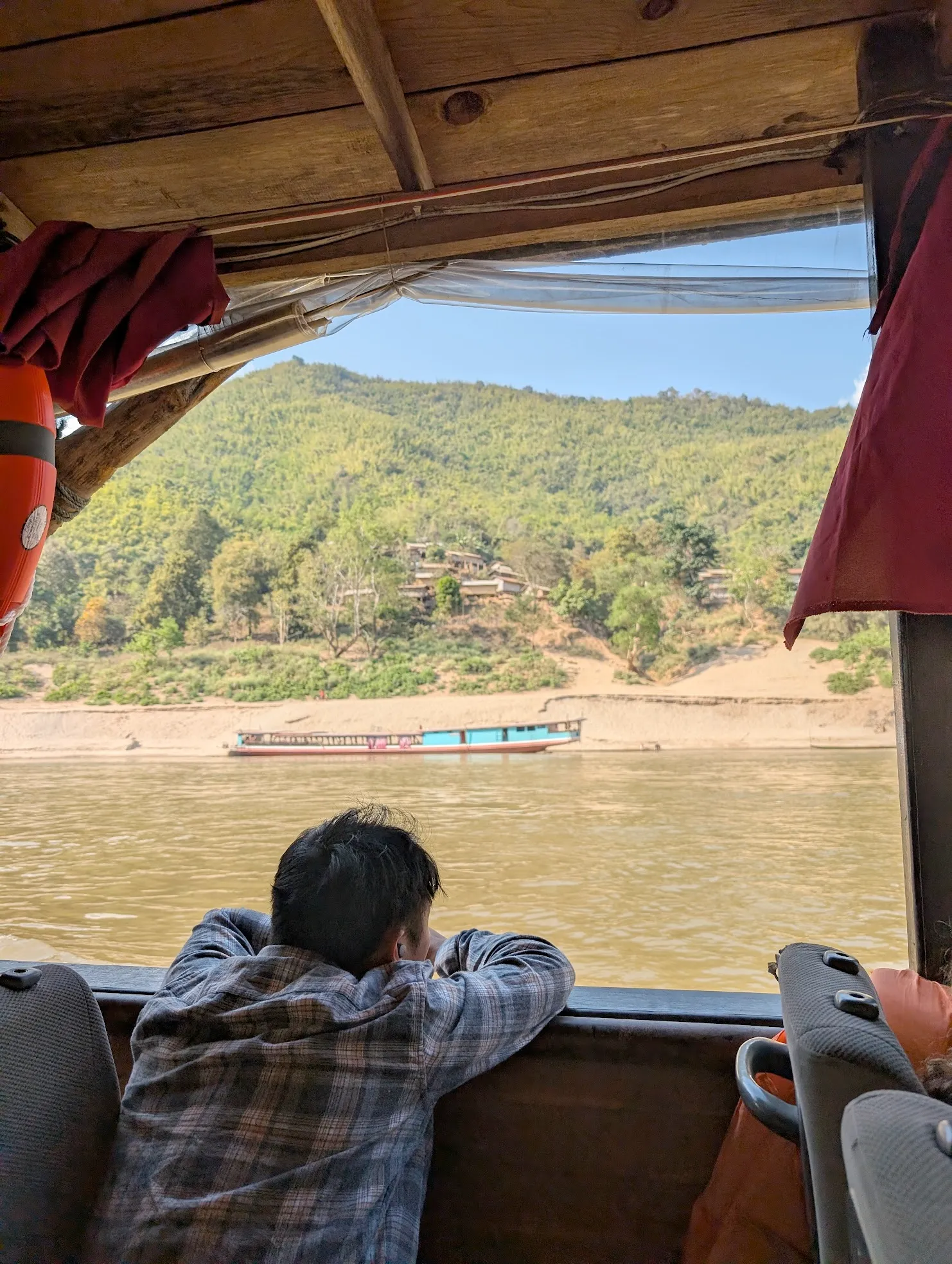 The view from the boat.
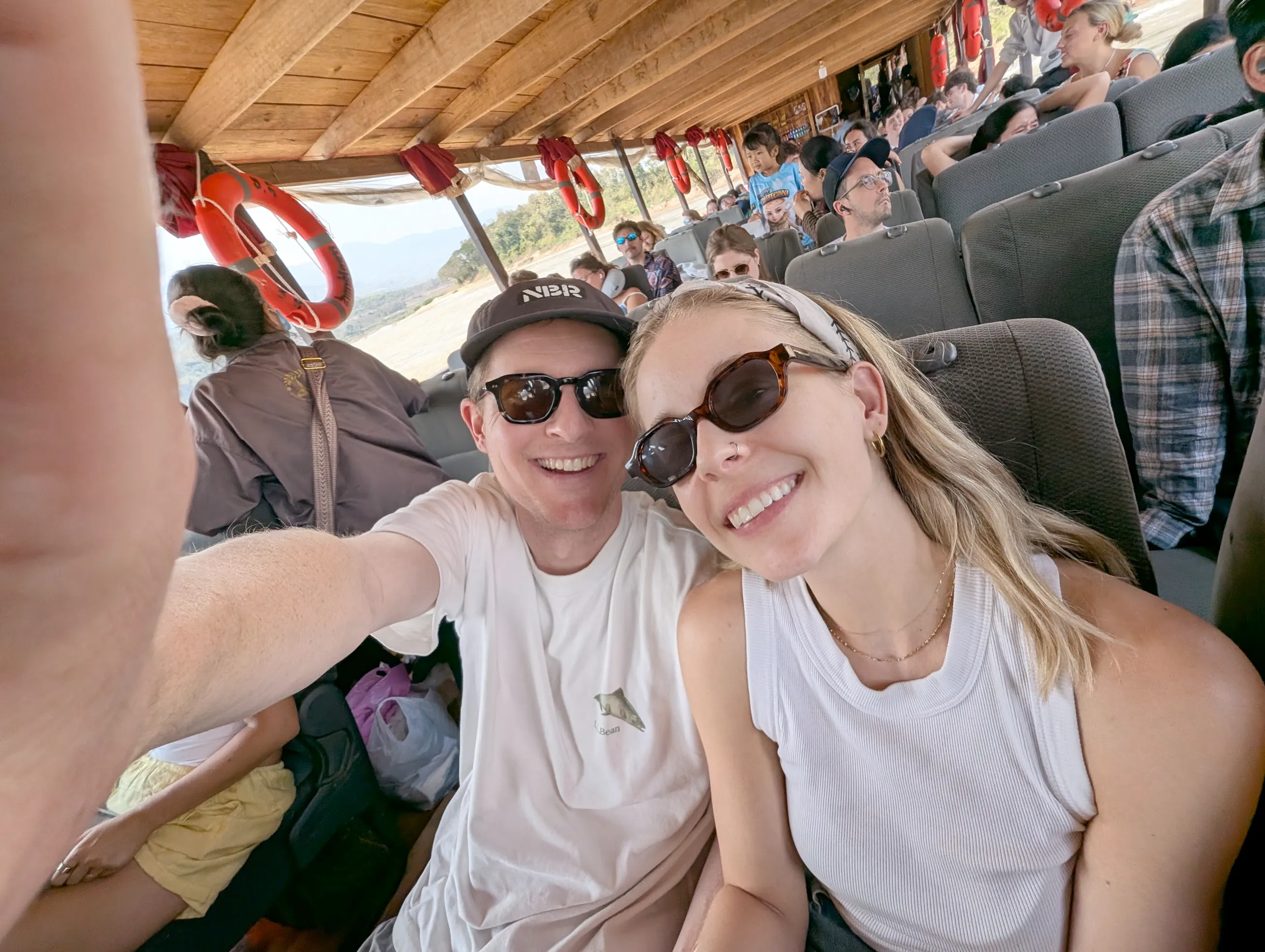 Yes, those are repurposed car seats.
Pak Beng
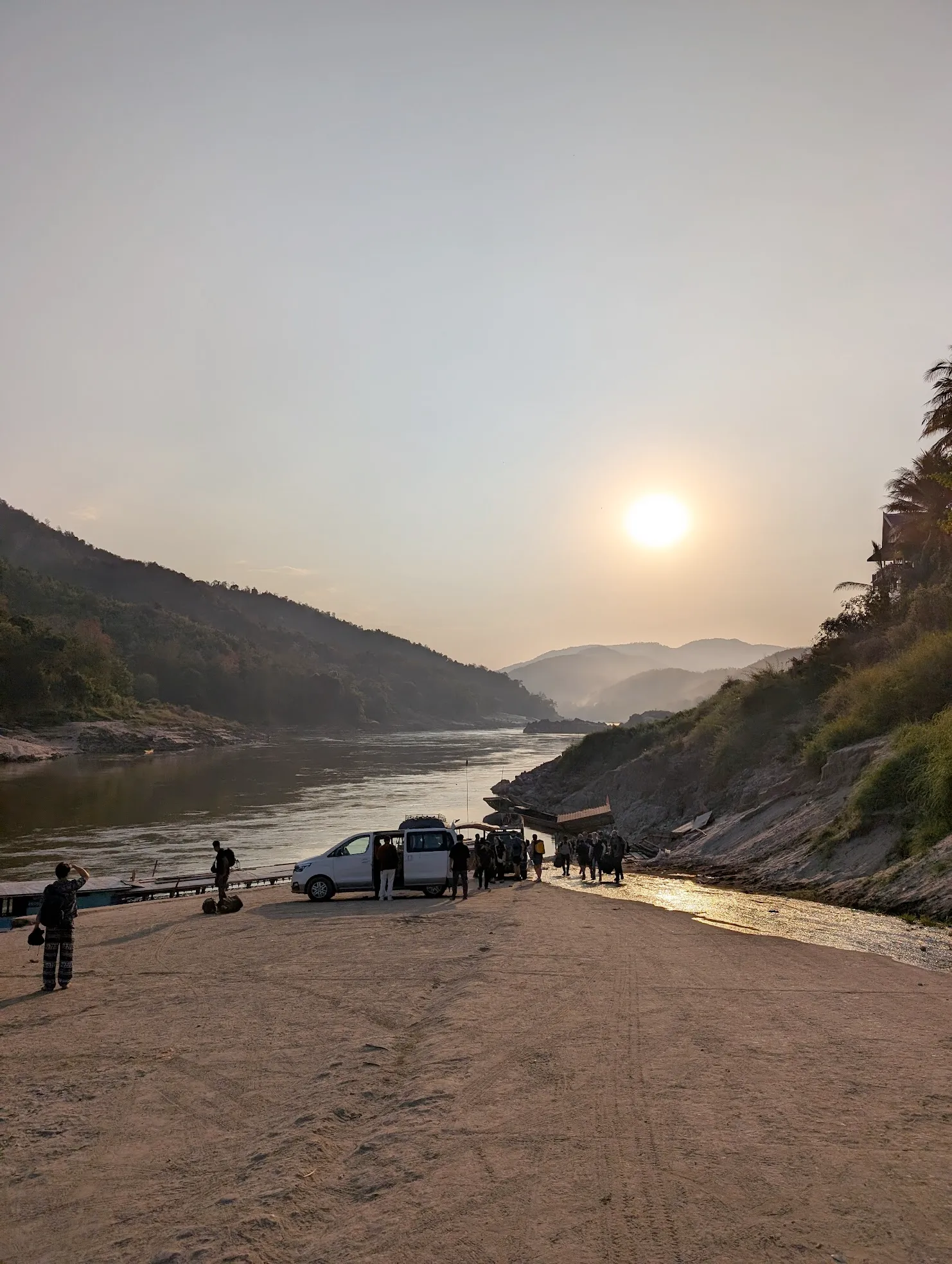 Late afternoon sun after arriving in Pak Beng.
Pak Beng is a small town at the junction of the Nam Beng river, the Mekong, and Route 2W. Much of the town appears to be oriented towards overnight visitors from the Slow Boat - you’ll find a slew of guesthouses, restaurants, and grocery stores. We enjoyed stretching our legs, taking a shower, and eating a full meal before an early bedtime. A few folks continued the night after dinner at a rooftop bar.
Slow Boat, Day 2 (Pak Beng to Luang Prabang)
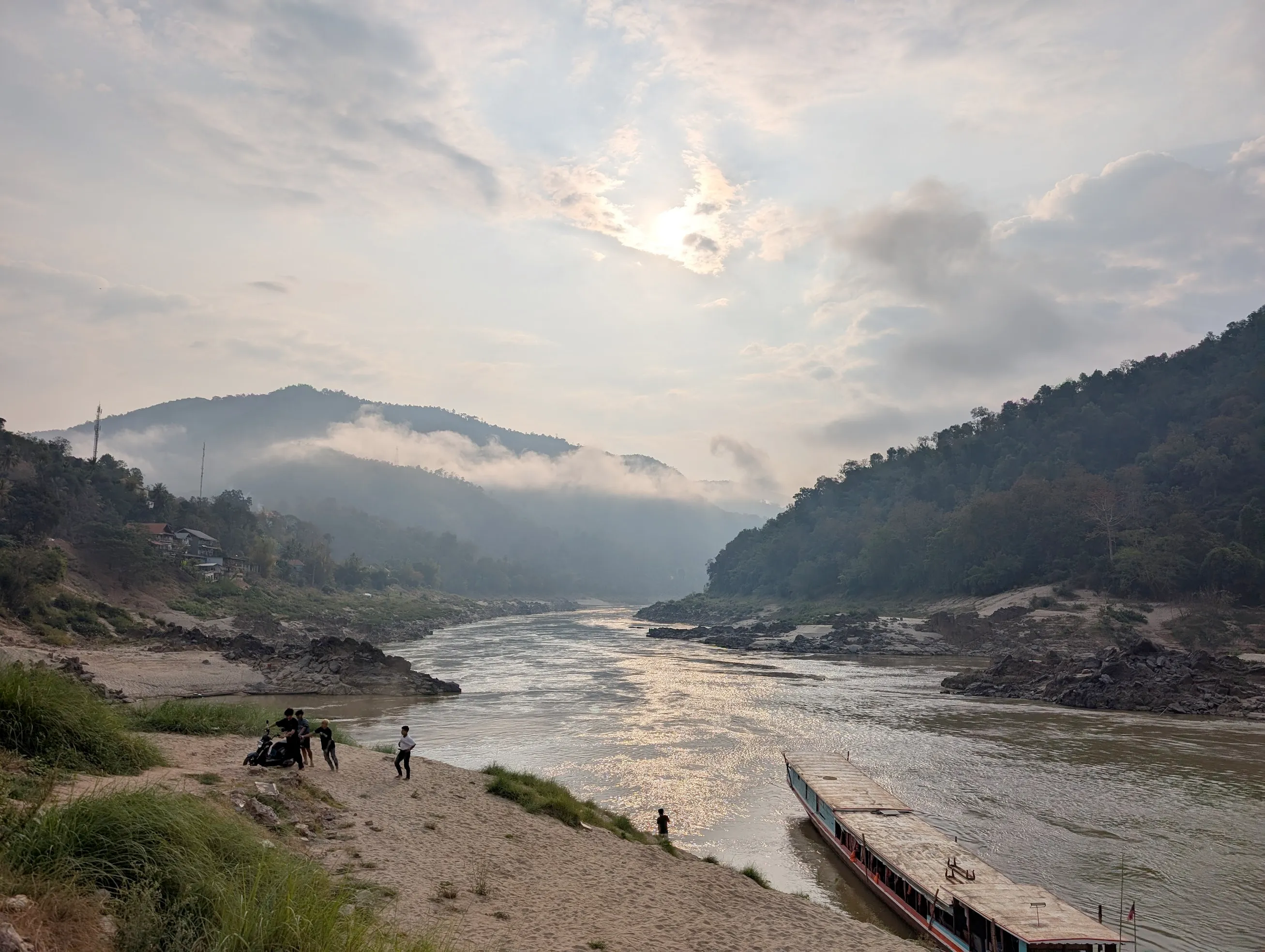 Early morning in Pak Beng.
The second day of the Slow Boat is much like the first, only a little longer and a little less novel. On this leg of the journey there were no assigned seats, so get there early if you feel strongly about engine proximity. Also unlike the first day, there were two boats from which to pick. The boat we boarded left promptly at 9 a.m., leaving the other boat behind temporarily. The two arrived in quick succession in Luang Prabang, however, so perhaps the second boat was a smarter pick.
The exuberance of the first day had mellowed, but spirits were still high. We played Schwimmen, a popular German card game that Andrej taught us, read, listened to music, and enjoyed the scenery. Part of what I loved about the Slow Boat was the fact that there is very little to do, and certainly no internet access. It reminded me of being a kid - sometimes we just got bored and had to figure out how to entertain ourselves. At the time I was reading The Heart of the Buddha’s Teaching by Thich Nhat Hanh and was struck by this passage:
Sometimes I ask one of my students, “What are you doing?” to help him release his thinking about the past or the future and return to the present moment. I ask the question to help him be — right here, right now. To respond, he only needs to smile. That alone would demonstrate his true presence. Asking yourself, What am I doing? will help you overcome the habit of wanting to complete things quickly. Smile to yourself and say, Washing this dish is the most important job in my life…if you wash one dish in mindfulness, if you build one small temple while dwelling deeply in the present moment — not wanting to be anywhere else, not caring about fame or recognition — the merit from that act will be boundless, and you will feel very happy.
The Slow Boat was a perfect chance to practice this kind of mindfulness. I have asked myself, “What am I doing?” on many occasions since then and have found it extremely helpful at bringing me back to the present moment.
After seven hours, we arrived at a pier just northeast of Luang Prabang, shared tuk-tuks into the city, and dispersed to our respective lodgings.
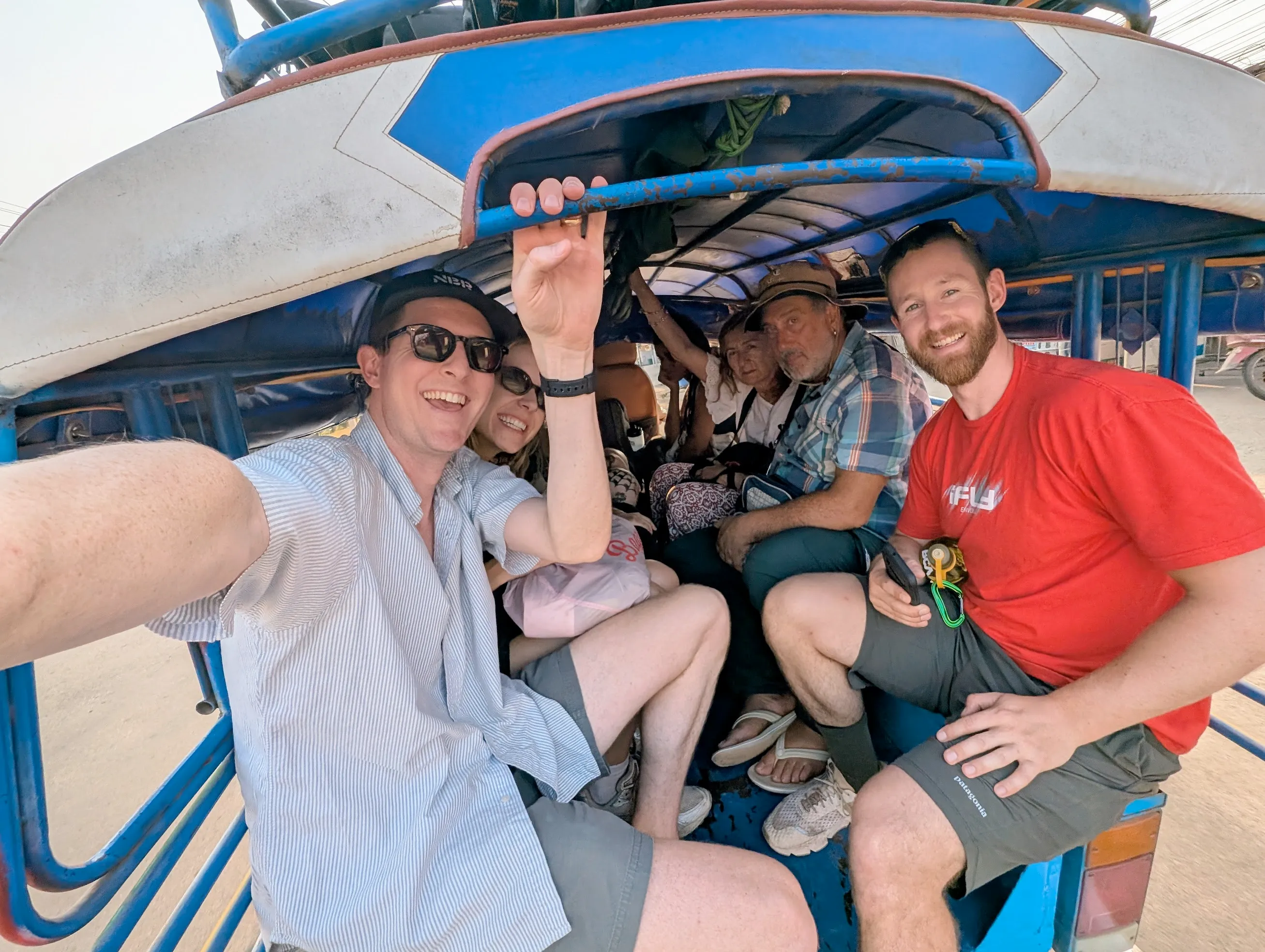 Makeda, Ian, and I en route to Luang Prabang.
Do I recommend taking the Slow Boat? It depends. If you don’t have two days to spare on your trip - obviously skip it. If you do, the fact remains that it is 13 to 14 somewhat uncomfortable hours on a boat, and once transit to the border, food, lodging, and the ticket itself are taken into account, you aren’t actually saving that much money compared to the $120 one-way flight I found while writing this blog. But that is precisely the wrong way to think about it - you do it for the journey itself. For the fun of navigating overland, across borders, and down the Mekong. For the opportunity to meet new people and see places that you’d otherwise never think about. For the chance to stay present in reality while going from place to place in a way that you just cannot do in an airplane. For Makeda and me, it was perfect.
Luang Prabang
Due to our earlier missed connection in Houayxay, we only had one night in Luang Prabang instead of the intended two. We were not able to extend our hotel, so we opted to simply shorten our Luang Prabang visit and maintain our existing Nong Khiaw dates. In hindsight, we would have enjoyed at least a full day in Luang Prabang.
We stayed at a wonderful guesthouse called La Casa Nostra run by an extremely friendly Filipino family. Luckily for us, they were hosting their weekly “family dinner” at their sister hostel down the street that night where we were treated to delicious food, conversation, and a standout karaoke performance from the owner’s five year old daughter.
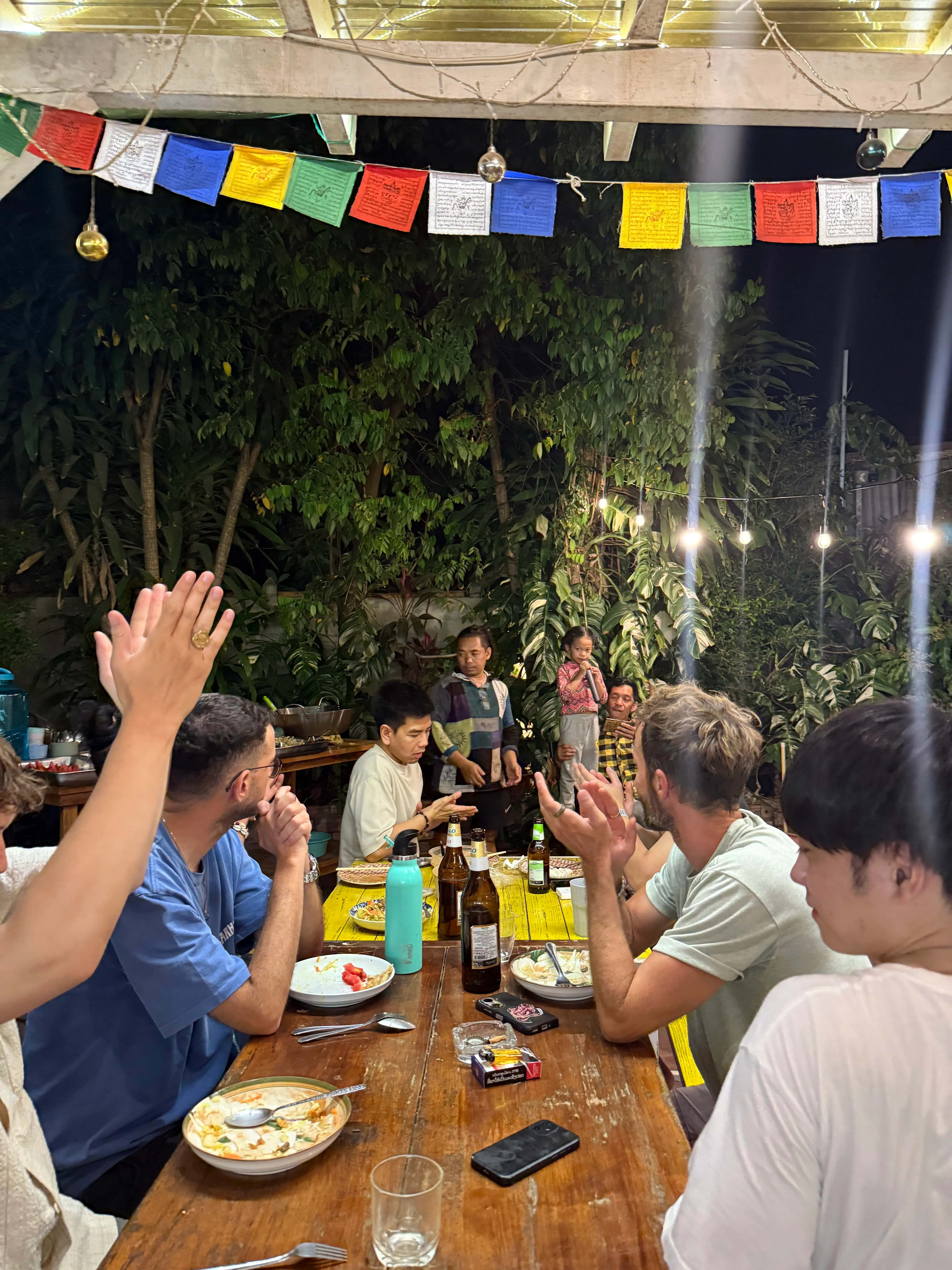 Karaoke at family dinner.
After dinner we met up with our new friends at Mad Monkey, a hostel with a lively bar area. Unfortunately for Makeda and me, we had an early departure the following day so we called it early. This was our departure from Andrej - he was continuing south to do the Thakhek motorcycle loop.
Luang Prabang to Nong Khiaw
The most common route from Luang Prabang to Nong Khiaw is by minibus — a four-to-six-hour ride northeast on a winding, deeply rutted road that follows the Nam Ou. Ideally, Makeda and I would have taken a boat the entire way, as the two towns are connected by the river. But since 2016, China has built seven dams on the Nam Ou as part of its Belt and Road Initiative, two of which sit between Nong Khiaw and Luang Prabang. Consequently, we had to take a two hour minibus ride up the Nam Ou to the second dam. Personally, this was the worst section of the entire journey - crammed in a minibus going at least 40 MPH while passing tuk tuks on blind curves, all while being jostled on crater-like potholes. We made it without tossing up our lunch, but just barely. I can’t imagine what the full journey is like.
We boarded our boat just north of the second dam with three new companions, a guide, and a captain. Compared to the Slow Boat, this was similarly proportioned, but a quarter of the size. After the harrowing car ride, being in the open air, calmly making our way up the gentle river, feet dragging in the cool water - it was enough to swear off cars forever.
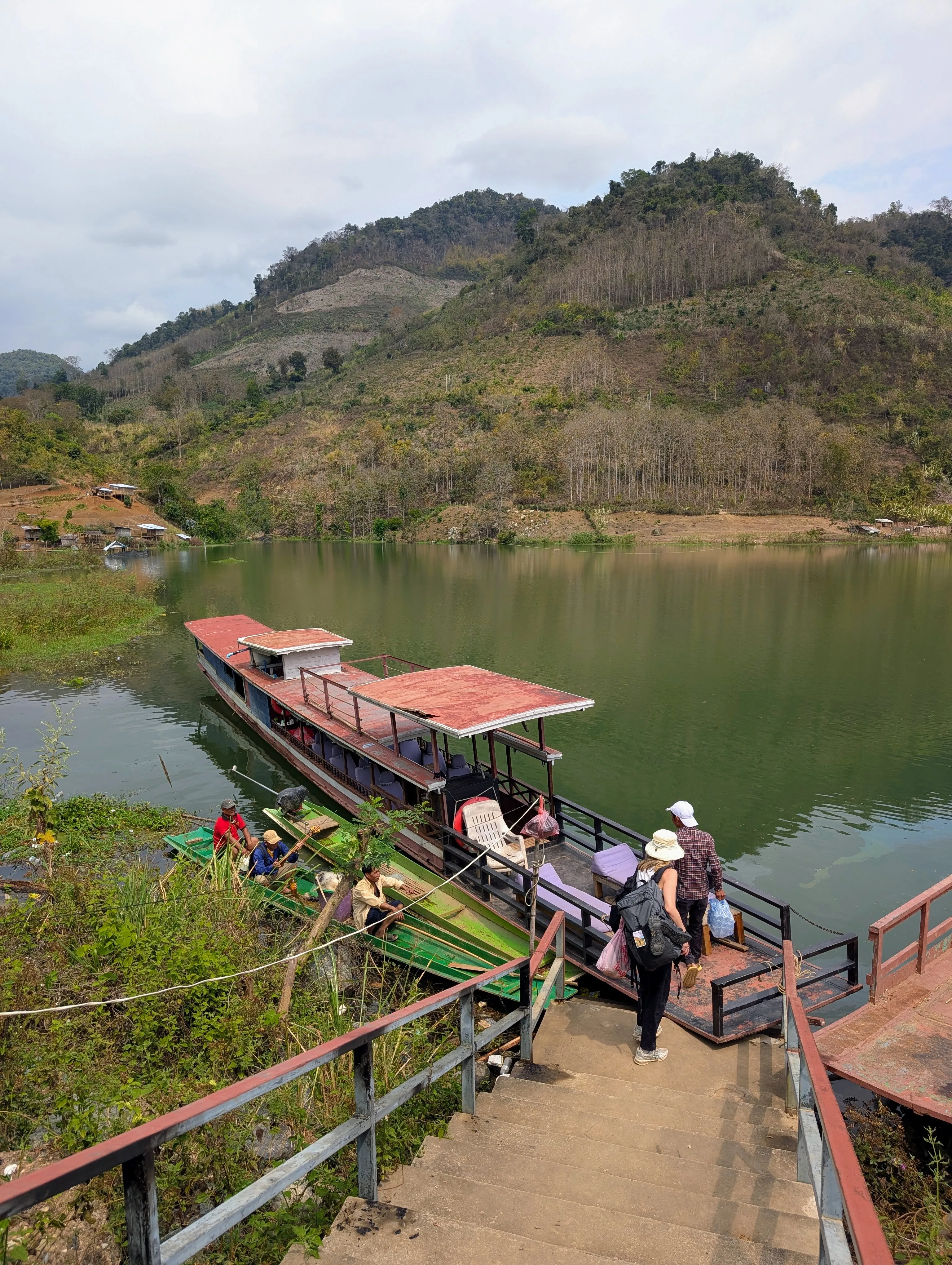 Our boat for the Nam Ou journey.
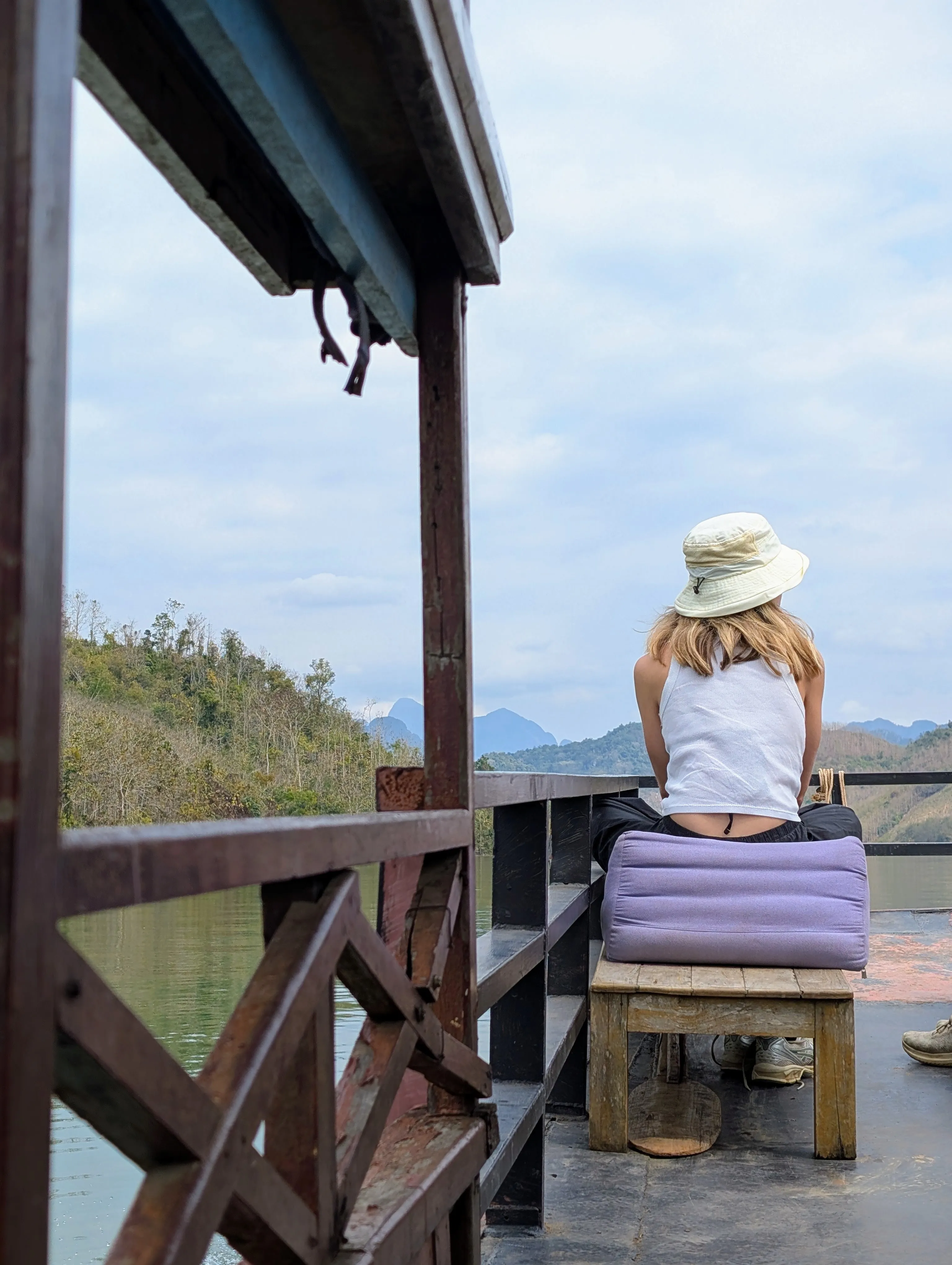 Makeda enjoying the boat ride.
I had not quite realized it when booking, but the boat journey included a stop at a small village on the Nam Ou and a short hike. We were given a brief tour of the village before being introduced to our local guide for the hike. We took a short 2-3 mile hike up the valley, past rice paddies and rubber tree groves, to a modest waterfall with a small pool. We all cooled off in the water before returning to the village.
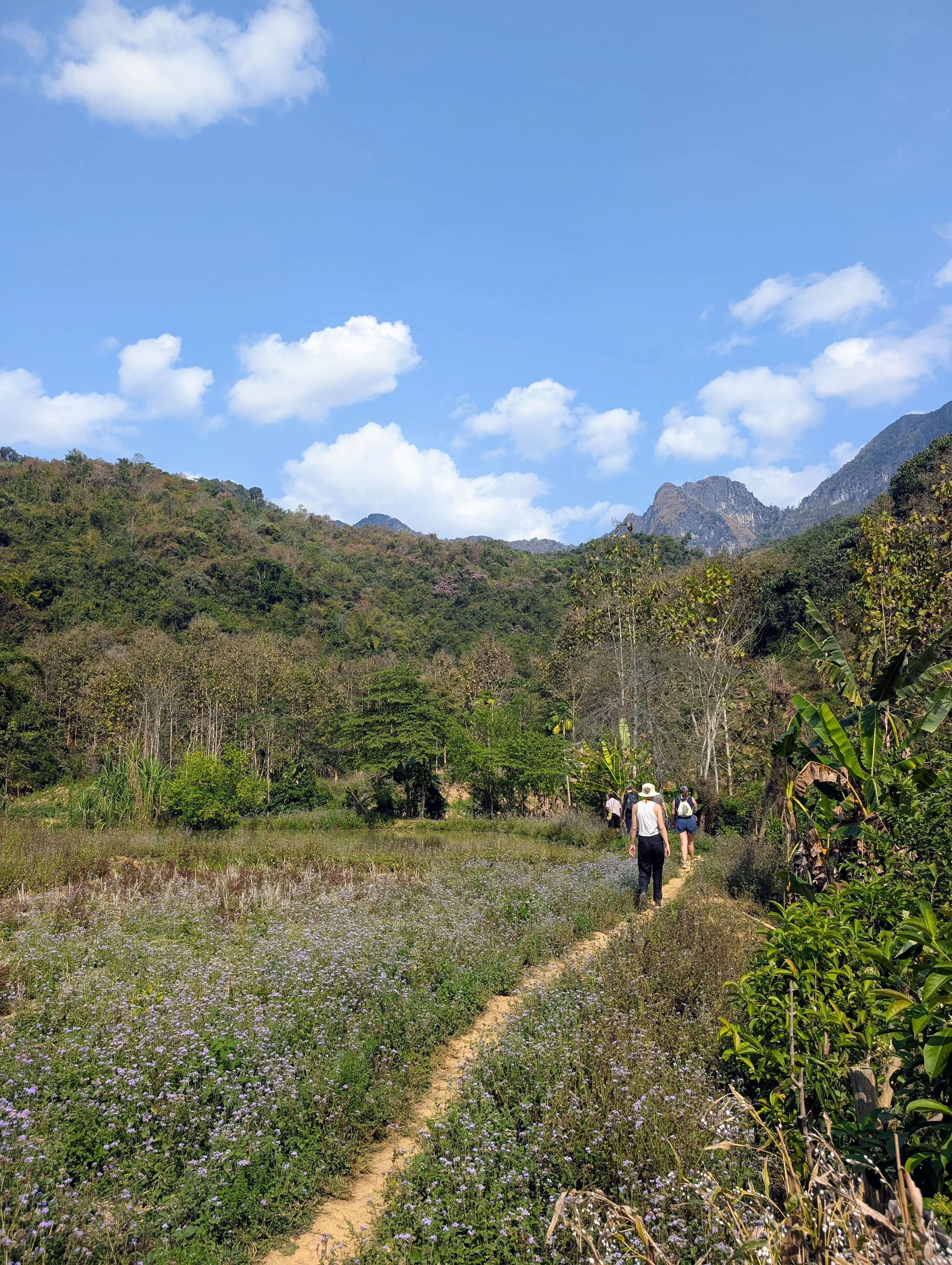 En route to the waterfall.
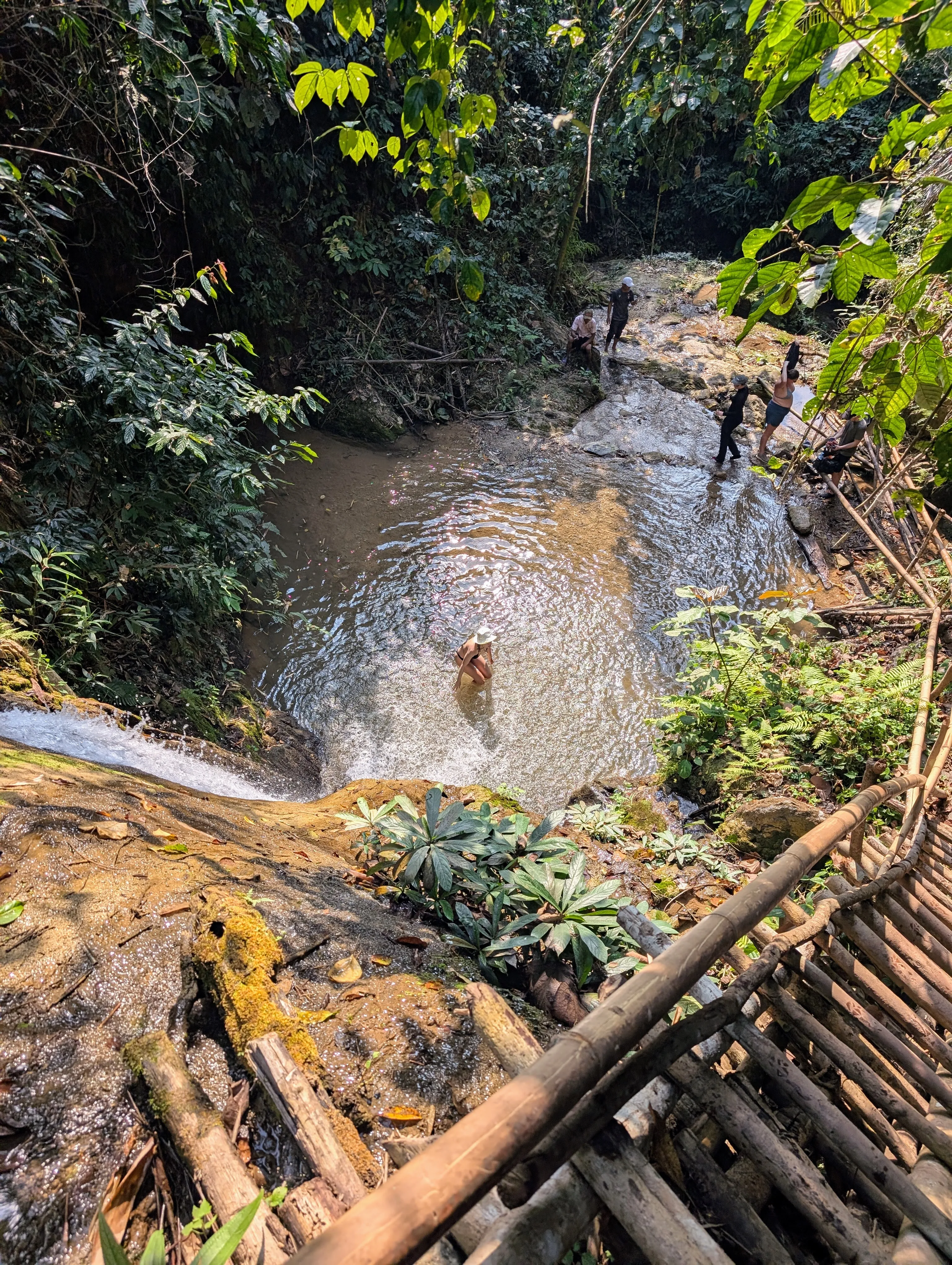 Makeda enjoying the waterfall.
The remainder of the boat ride was idyllic. We floated by karst mountains in the late afternoon light while dozing on the bow, reading, and getting to know the other folks on the boat. This section of the Nam Ou valley is genuinely stunning. We saw fishermen hauling in their evening catch, children play along the banks, and other boats passing downriver. After a couple relaxing hours, we arrived in Nong Khiaw.
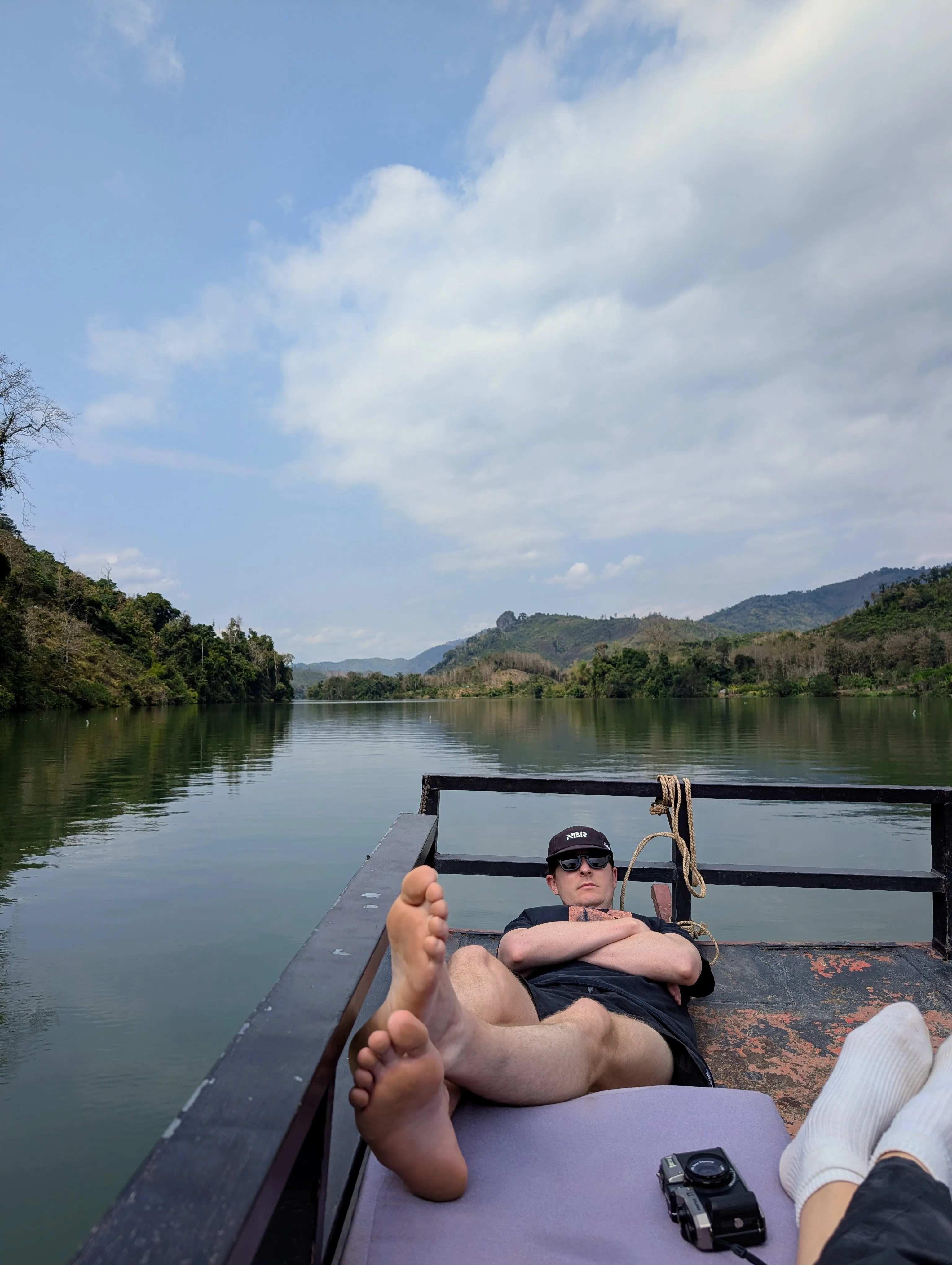 One million times better than a bus.
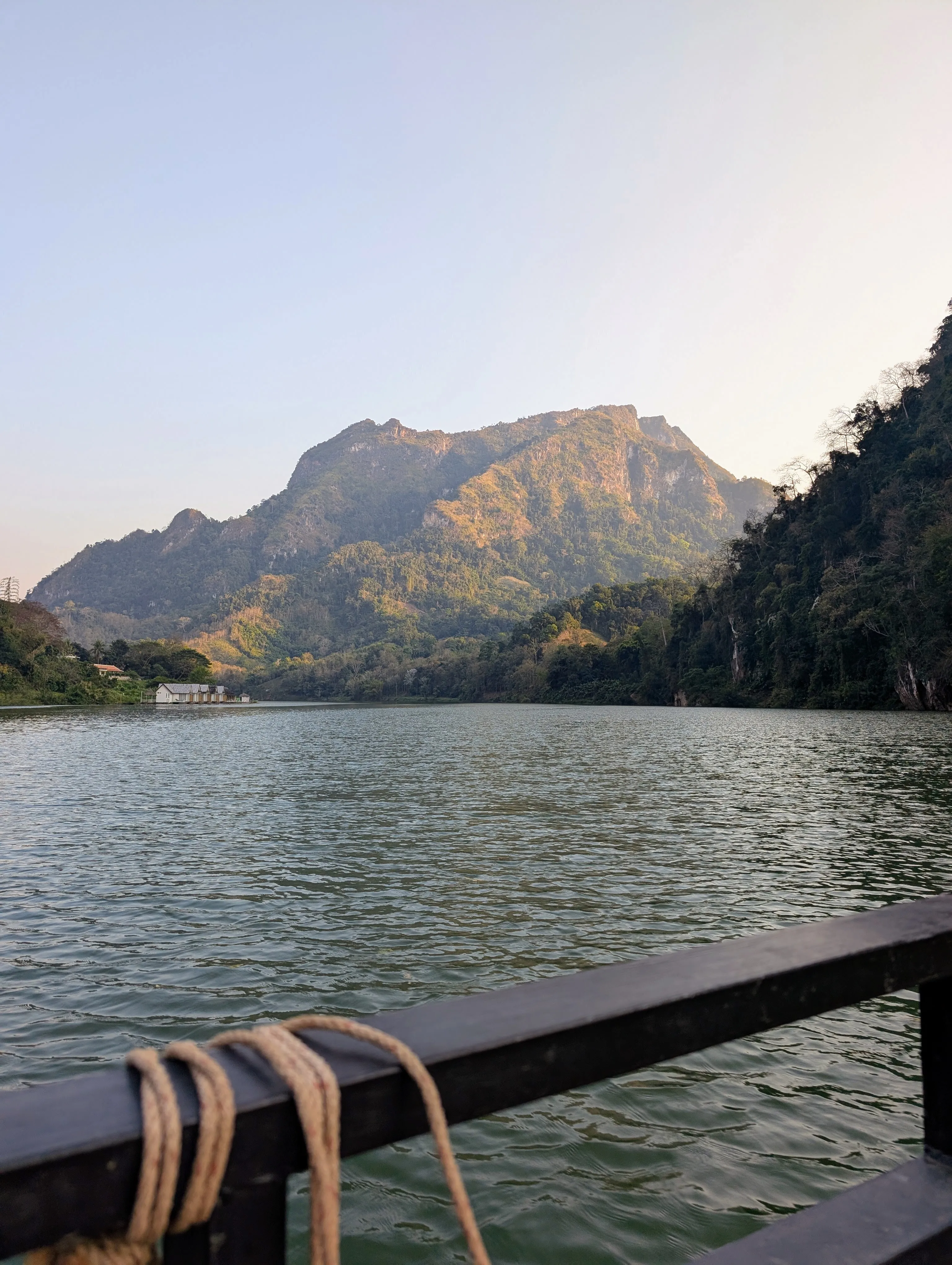 Approaching Nong Khiaw on the Nam Ou.
Nong Khiaw
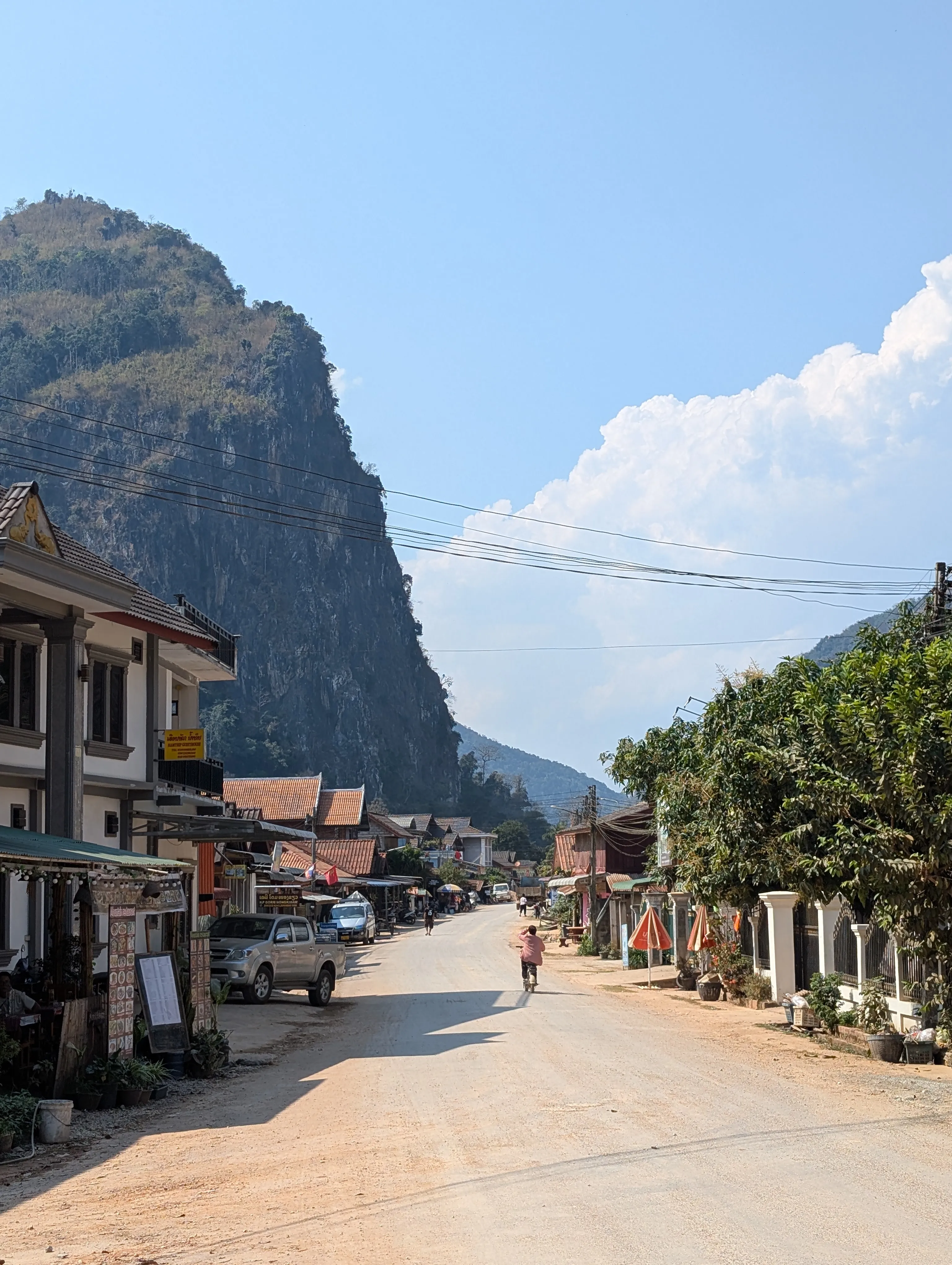 Nong Khiaw.
When planning this trip, I had no idea that Nong Khiaw is a popular destination from Luang Prabang. I had more or less looked at a map of Laos and noted that the two are connected via the Nam Ou, and that the river continued on towards our ultimate destination of Vietnam. I had done some brief research to confirm that Nong Khiaw had at least one guesthouse and that transit up the river was possible, but I did not realize that Nong Khiaw is actually one of the more popular trekking and outdoor locations in Laos.
We took it easy the first few days, mostly reading, playing cards, swimming, and planning the next legs of the journey. After moving every day or two it was wonderful to settle into a place for a bit and chill. Eventually Ian and Xinyi made their way up from Luang Prabang, so we reconnected with them. Makeda and I also rented a scooter and spent a day exploring the valley. We visited the Pha Thok Cave, which was used in various capacities during the Laotian civil war and America’s covert bombing campaign in Laos during the Vietnam War. Upon entering the area, we were promptly escorted into the cave by two very enthusiastic tour guides, neither older than the age of 8. From there we continued down the valley to the Nong Ian waterfall (in reality, a small cascade), which turned out to be a popular weekend picnic location for local families. We grabbed a few Beerlao and some snacks and cooled off in the water, while Makeda immediately befriended most of the kids playing in the creek.
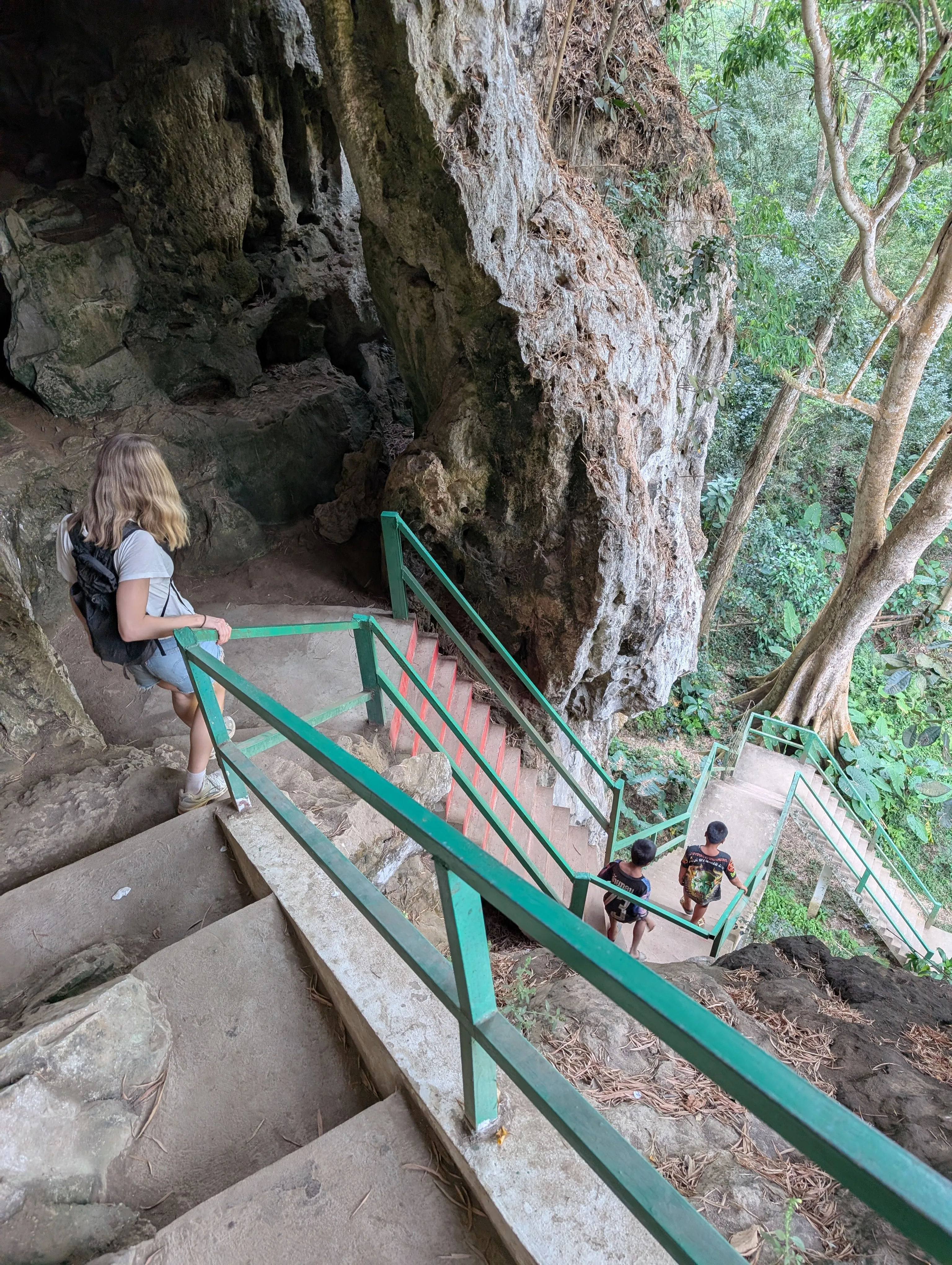 Our guides showing us out of the cave.
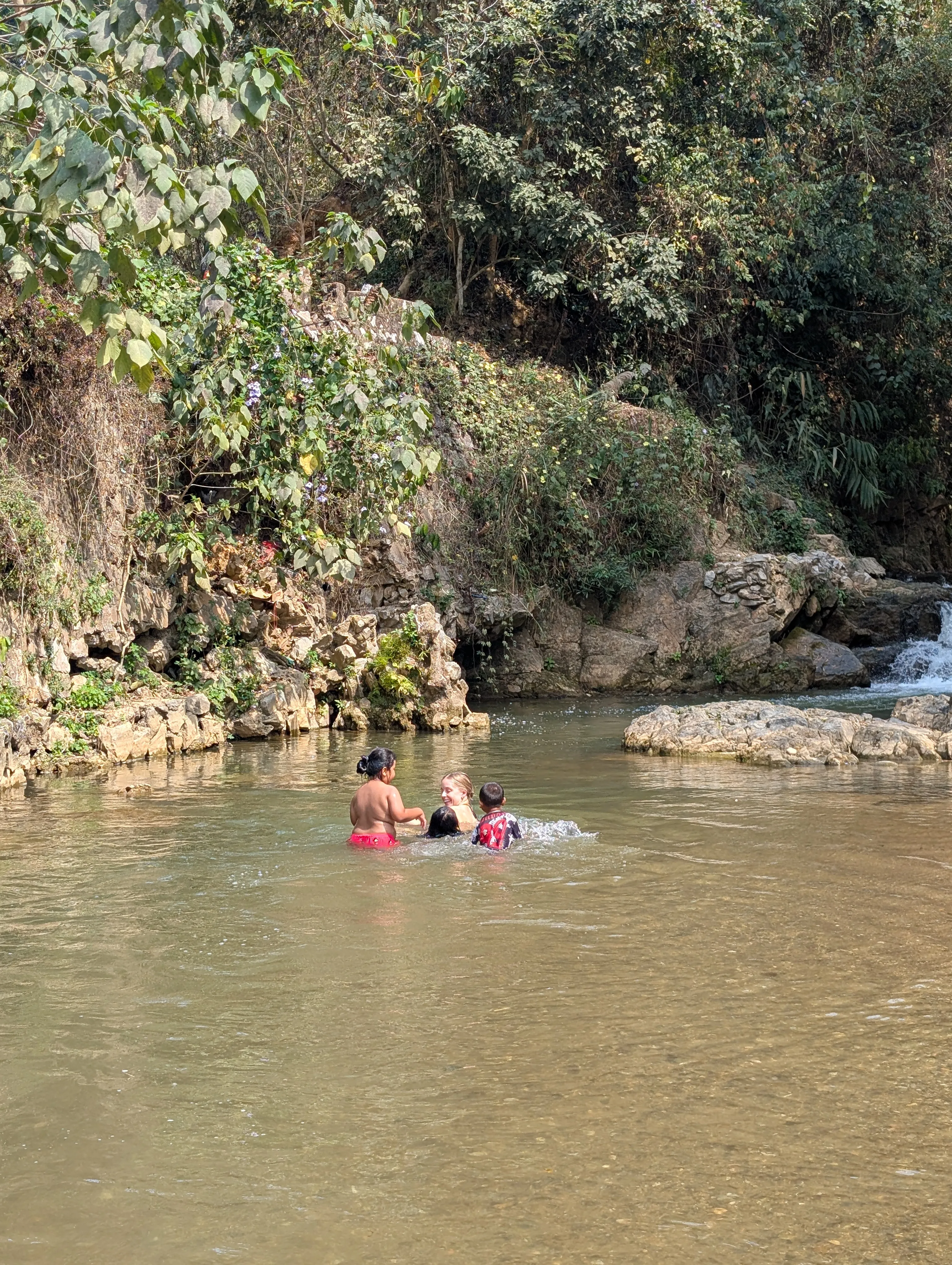 Makeda and her new friends.
Everest Hike
Tour companies throughout Nong Khiaw offer various combinations of jungle hikes, overnight visits to Sopchem and Muang Ngoy upriver, and summit treks. On Andrej’s recommendation we booked just the overnight vista hike, which the tour company called “Everest” - claiming to be the highest destination in the area. The itinerary was simple: hike up, sleep, and hike down. After a short pickup truck ride to the trailhead, we started the hike with a steep pitch up off the road. I naively thought that we would level out at some point and make our final approach to the summit gradually, but instead that inital steep pitch just continued all the way to the top. We climbed 4,646 feet in just over 3 miles. Who needs switchbacks?
At the summit we were greeted with a covered veranda, an exposed platform with views of the valley for us to sleep on, and one of the more rickity lookout towers I’ve encountered in my life. We were with a group of 25 to 30 other travelers. Everyone relaxed, enjoyed the views, played cards, and chatted. Before long dinner was served and everyone went to bed. The tour provided sleeping mats in the form of 1/4 inch yoga mats, so we were in for a firm night. In the morning we had coffee and breakfast with stunning views of the valley sunrise before hiking (or should I say sliding?) down the mountain.
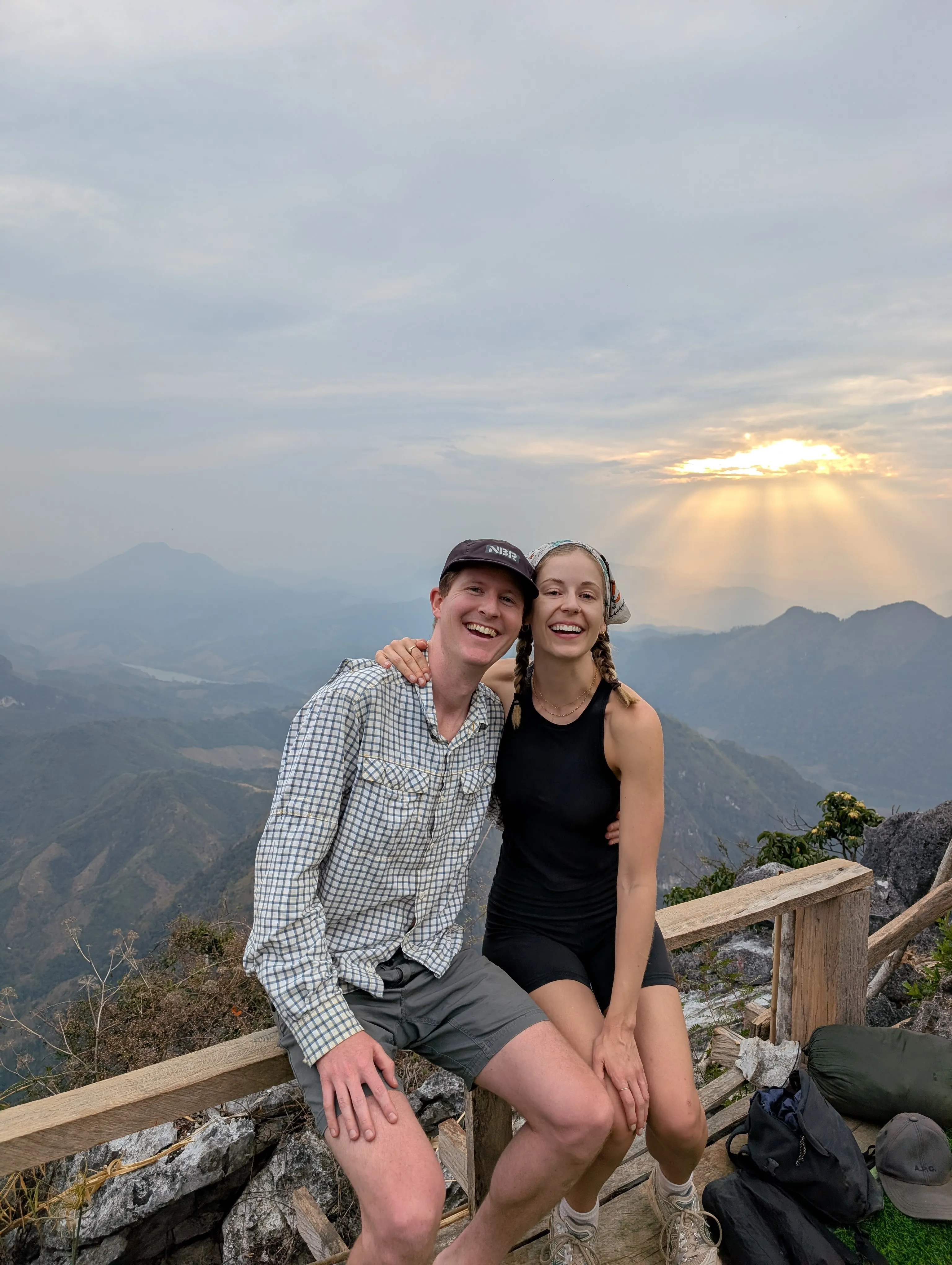 Happy to be at the summit.
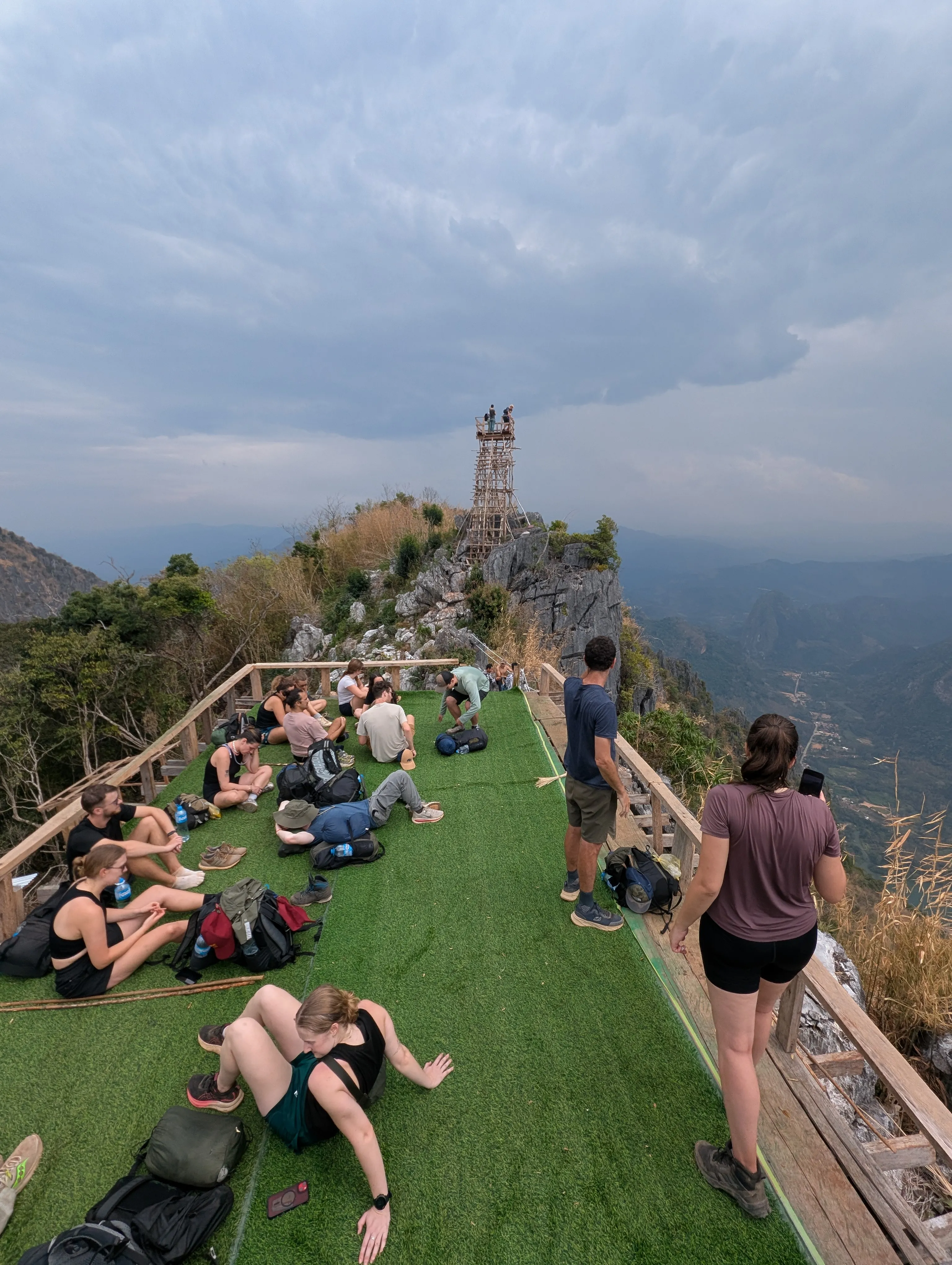 Sleeping platform with lookout in distance.
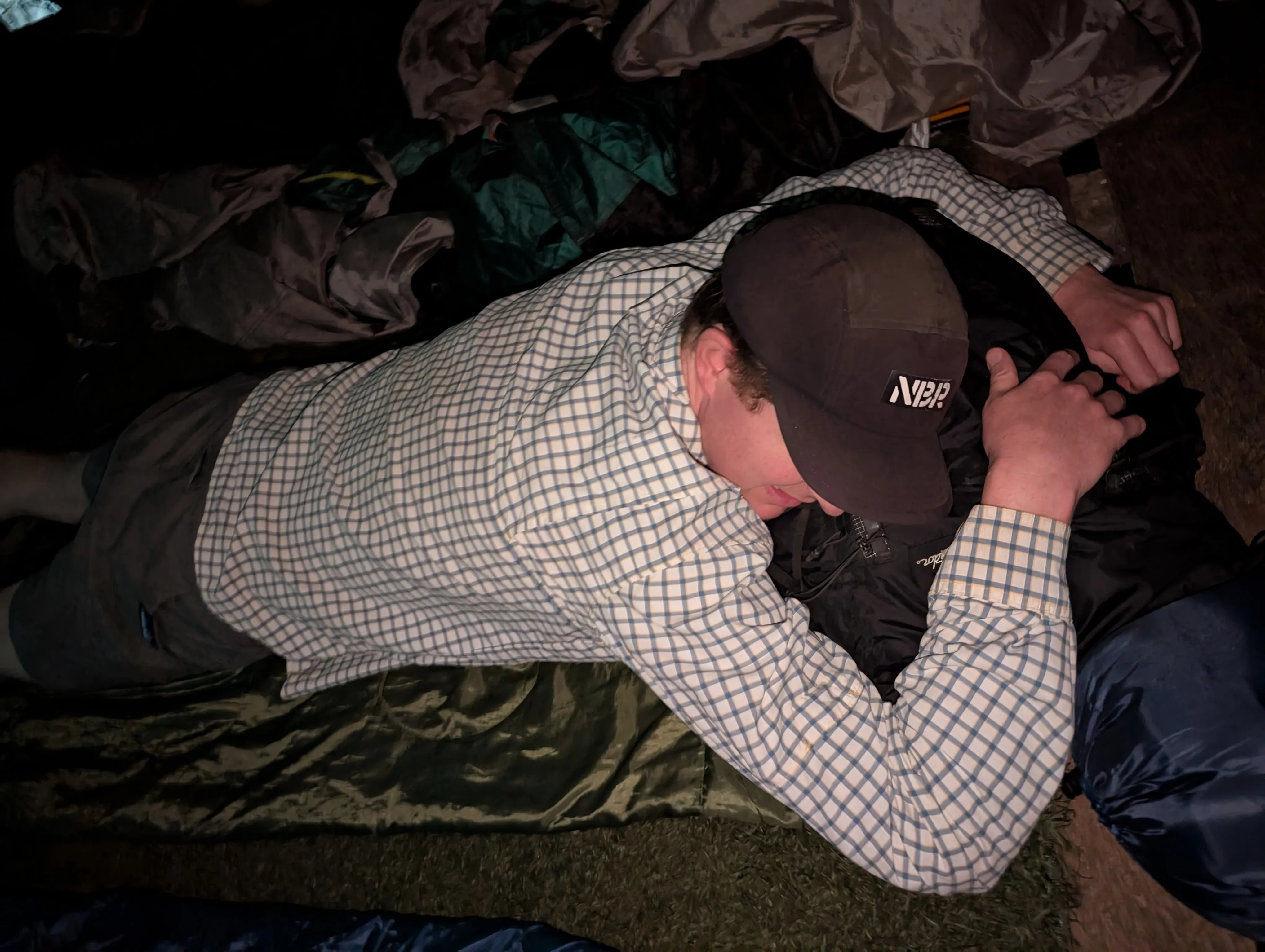 Nice and comfy!
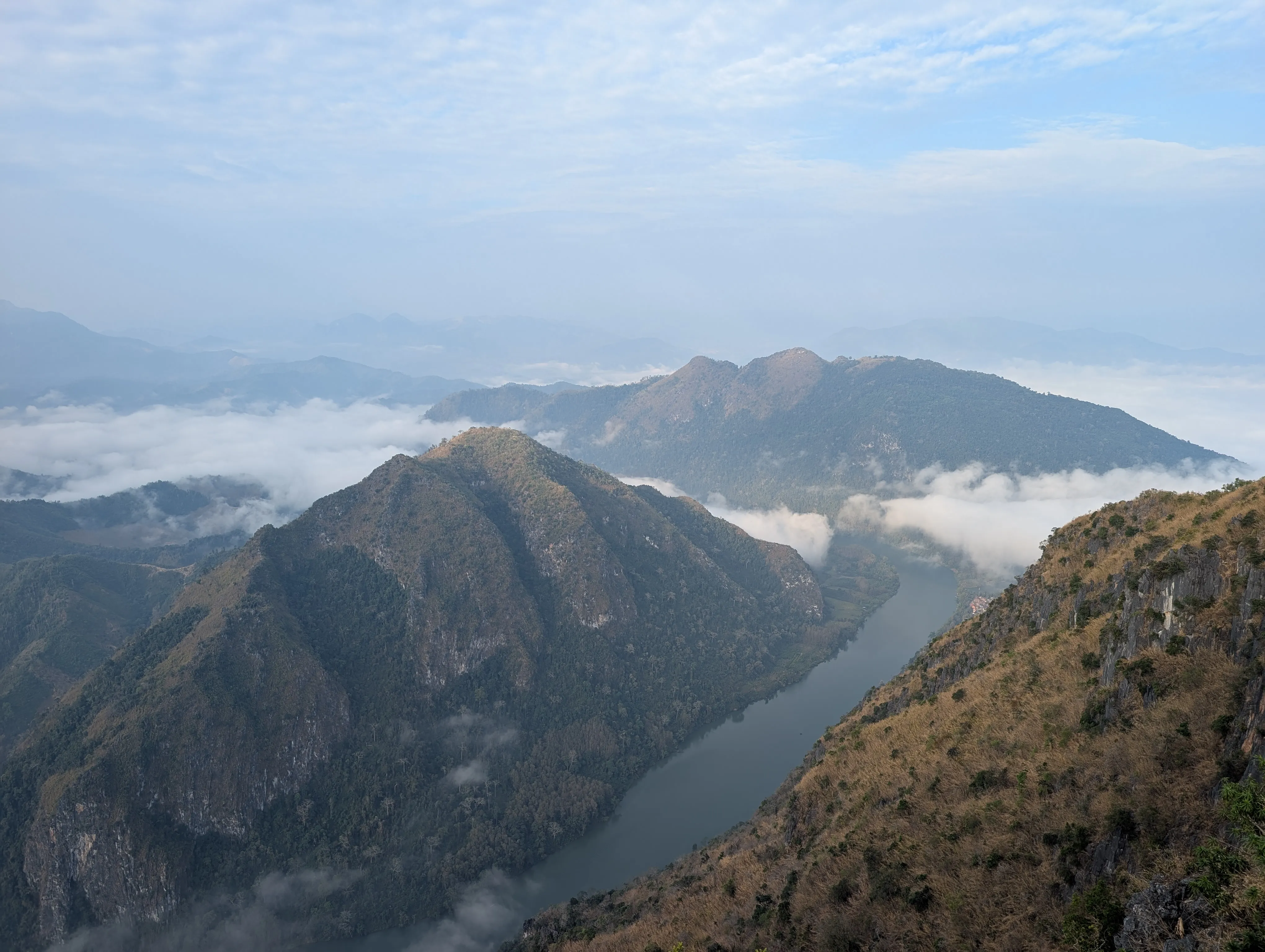 Morning views.
At this point, we were starting to think about the onward journey. However, it was around this time that we realized we had applied for our Vietnam visa just a few days prior to Tết, meaning that the approval would be delayed by at least a week. It had been more than a week since we applied, but the conflicting information online about processing times made it impossible to know whether we were one day or ten days away. Ready to move on from Nong Khiaw, we gave it a few more days; when the visas still had not come through, we booked a minibus back to Luang Prabang, intending to wait there or, if necessary, pivot to Cambodia. That morning, in a beautiful stroke of luck, I woke up to an email saying our visas were approved. We immediately cancelled our bus and bought our boat tickets upriver.
Nong Khiaw to Muang Khua
This journey consists of a three-hour boat ride to another one of the seven Nam Ou dams, a pickup truck ride around the dam, and another four-hour boat ride to Muang Khua. The first boat departed Nong Khiaw at 11 a.m. and appears to run daily. These boats were much smaller and much less comfortable than the Slow Boat, with seating consisting of a narrow wooden plank lining the sides of the boat and the protuding gunwale for a backrest. What the journey lacked in comfort it made up for in scenery and excitement.
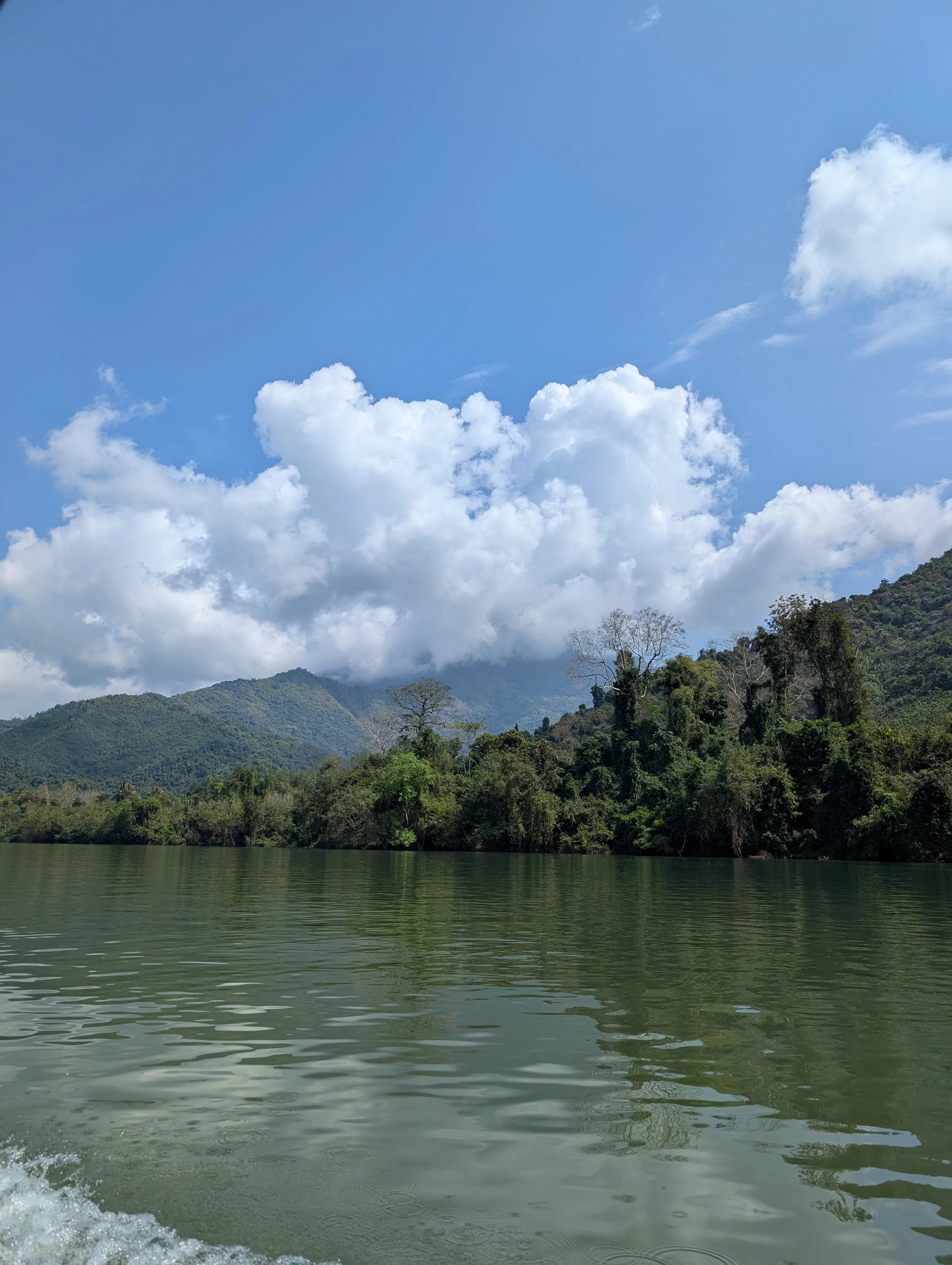 Just south of Sopchem on the Nam Ou.
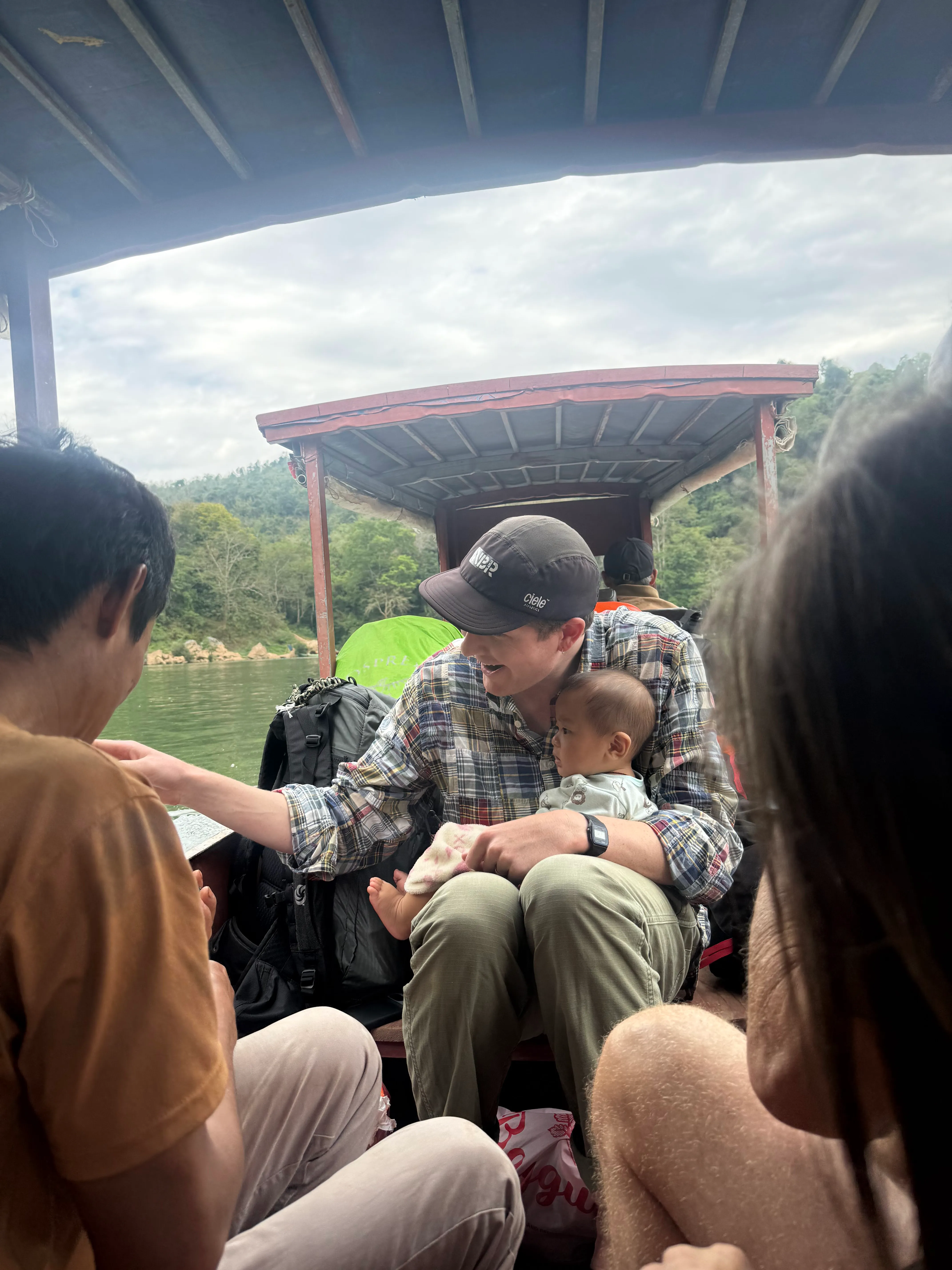 I got to hold the sweetest baby!
At the first dam we crammed into the back of a pickup, with myself and a Polish guy named Patrick hanging on the back. After a bumpy ride around the dam, we stopped at the pier and I jumped off the truck, thinking we had come to our stop. However, the driver intended to turn around and starting backing up into me, so I stumbled backward and promptly crashed into a parked motorcycle, sending both of us tumbling to the ground. Thankfully only my pride was injured.
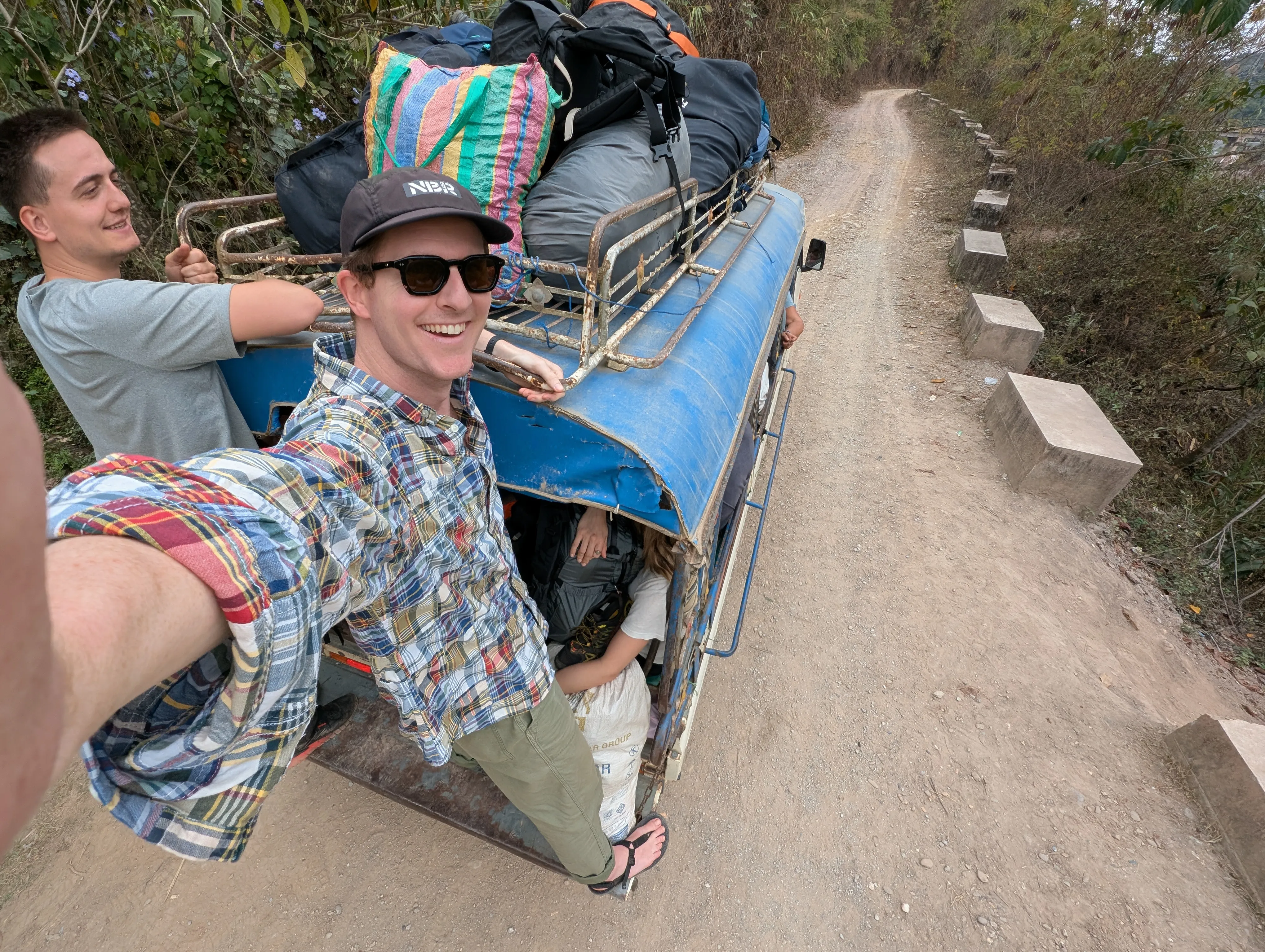 Going around the dam.
The second leg of the river trip was going smoothly for a couple hours before the engine started making deep growling noises and emitting huge plumes of smoke. Our captain and his crew managed to keep the engine running long enough to make it to a small homestead on the bank of the river, where we all temporarily disembarked - unsure of the fate of our remaining journey. Before we knew it, the captain had stripped down to his underwear and was bailing out the boat while the crew fixed the engine. His crew promptly erupted into laughter, and the captain was grinning ear to ear - seeming to enjoy the unexpected swim. Another boat full of locals pulled up and joined in the levity of the situation. This unplanned stop provided a quick bathroom break and a nice stretch of the legs, and before long the engine was up and running. We continued to Muang Khua without any more issues.
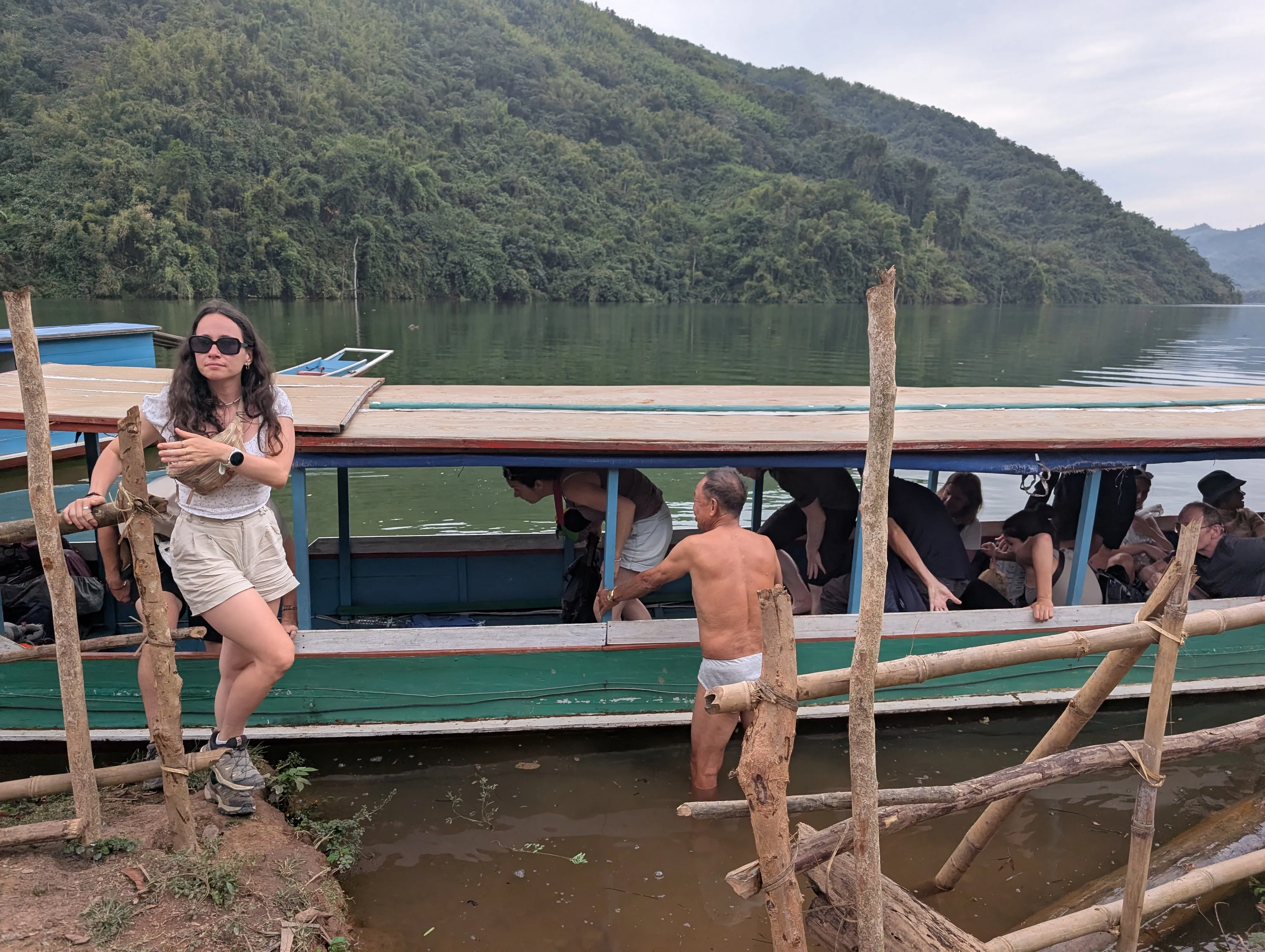 Our fearless captain!
Muang Khua
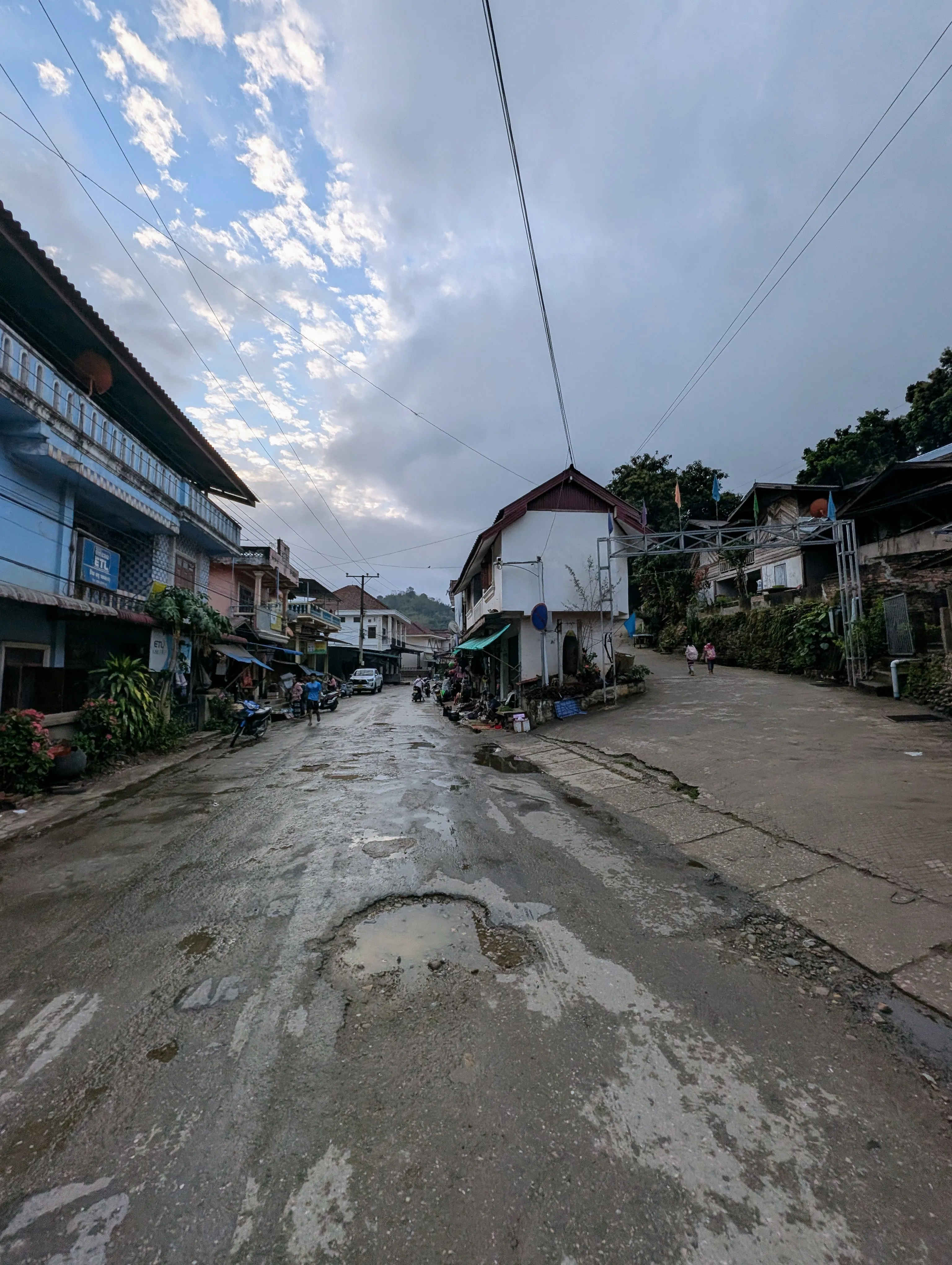 Rainy morning in Muang Khua.
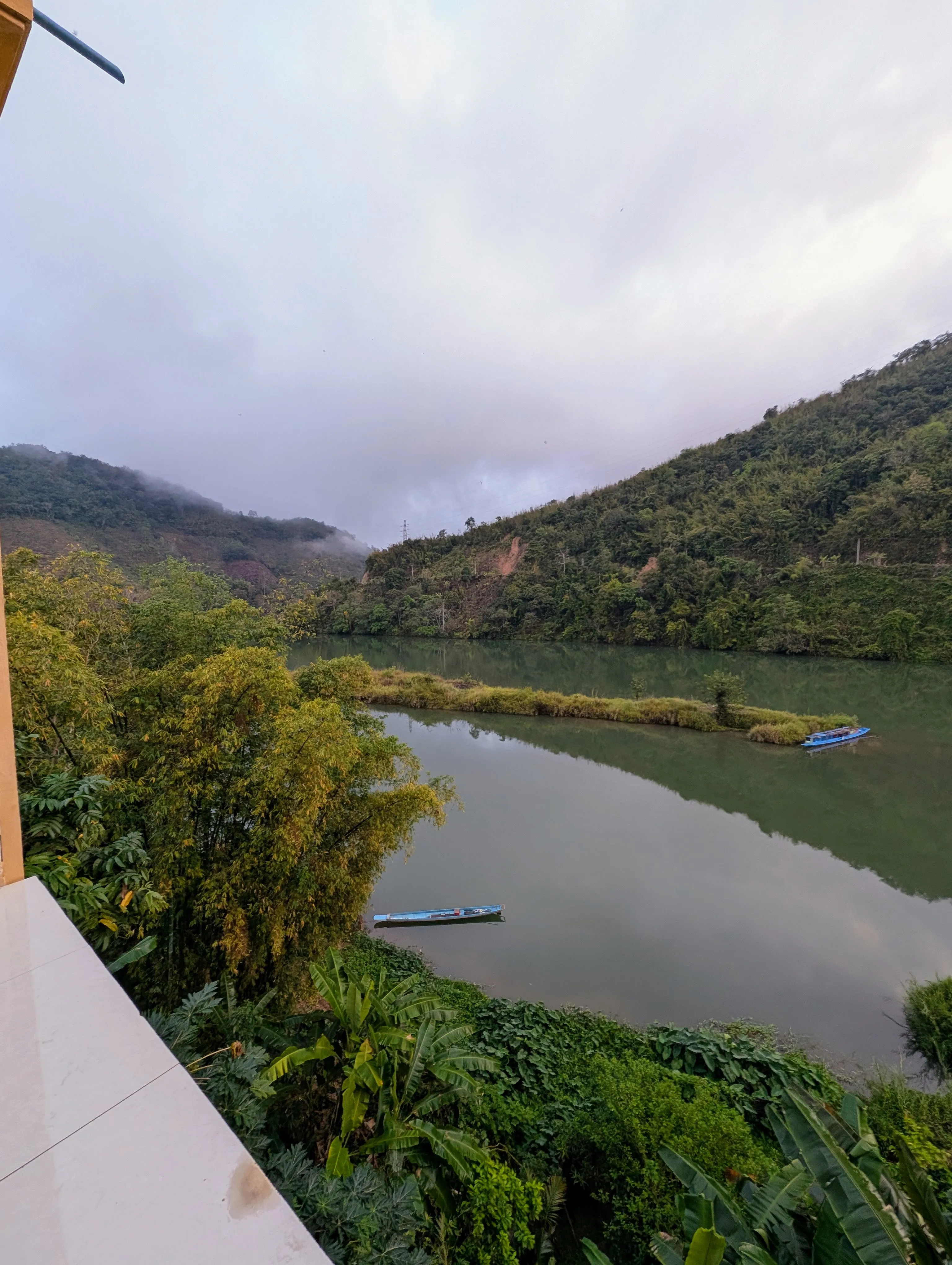 Nam Ou from our guesthouse.
We stayed just one night here before catching the bus to the border, but Makeda and I were pleasantly surprised by this small riverside town. Essentially everyone on the boat checked in to the same guesthouse near the pier, which to date is easily the highest value lodging we have used. For 250,000 kip ($11.65) we had a private room, AC, comfortable twin beds (not to be taken for granted!), a TV, and hot water in the shower. After getting settled we had dinner with our new Polish friends Patrick (who saved me on the truck) and his wife Natalia.
Muang Khua to Điện Biên Phủ
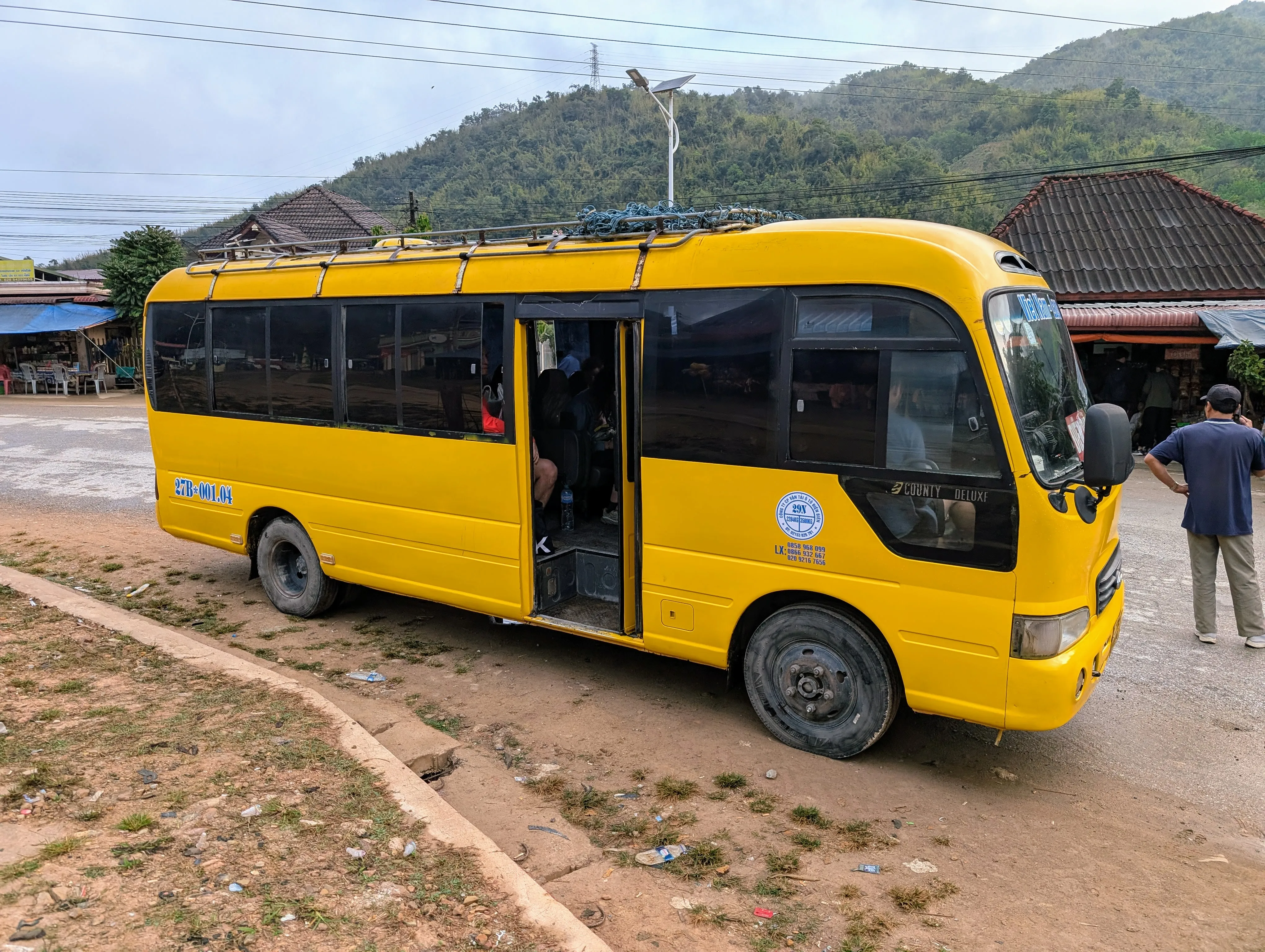 Our bus to Vietnam.
Unfortunately, the Nam Ou does not flow into Vietnam, so the final portion of the journey would be a three-to-four-hour bus ride through the northeastern Lao mountains. We caught the bus at 7:30 a.m. with Patrick and Natalia and several other folks from the boat the previous day. I ended up with a fold-out aisle seat with no seatbelt, but I at least had some room in front of me to stretch my legs.
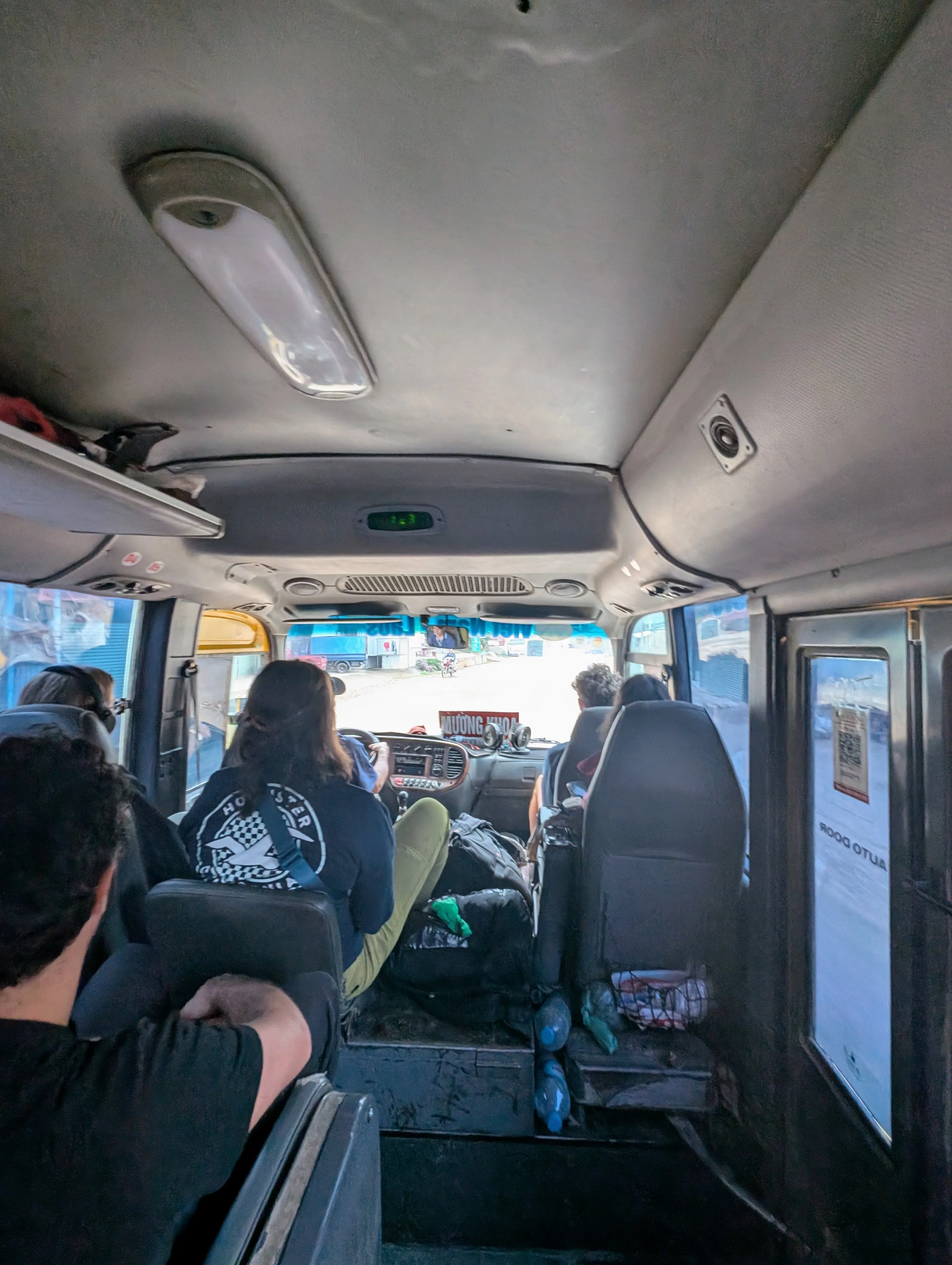 The view from my seat.
The drive to the border was slow as we climbed up and out of the river valley, which helped manage my carsickness on the windy mountain road. When I could manage a glance out the window I was greeted with stunning views of misty, forested hills and terraced rice paddies far below. Compared to the white-knuckle minibus ride from Luang Prabang, this was a pleasure. After a couple hours we arrived at the Lao border control, where we all got out and cleared customs and stretched our legs. The bus then took us a kilometer or so to the Vietnamese side. I had read that printed visas were required, but the border agent accepted the digital copy on my phone. We exchanged our remaining kip for dong, bought snacks and reboarded for the final hour — a winding descent into the Điện Biên valley. The roads were well paved, and we arrived safely at the station.
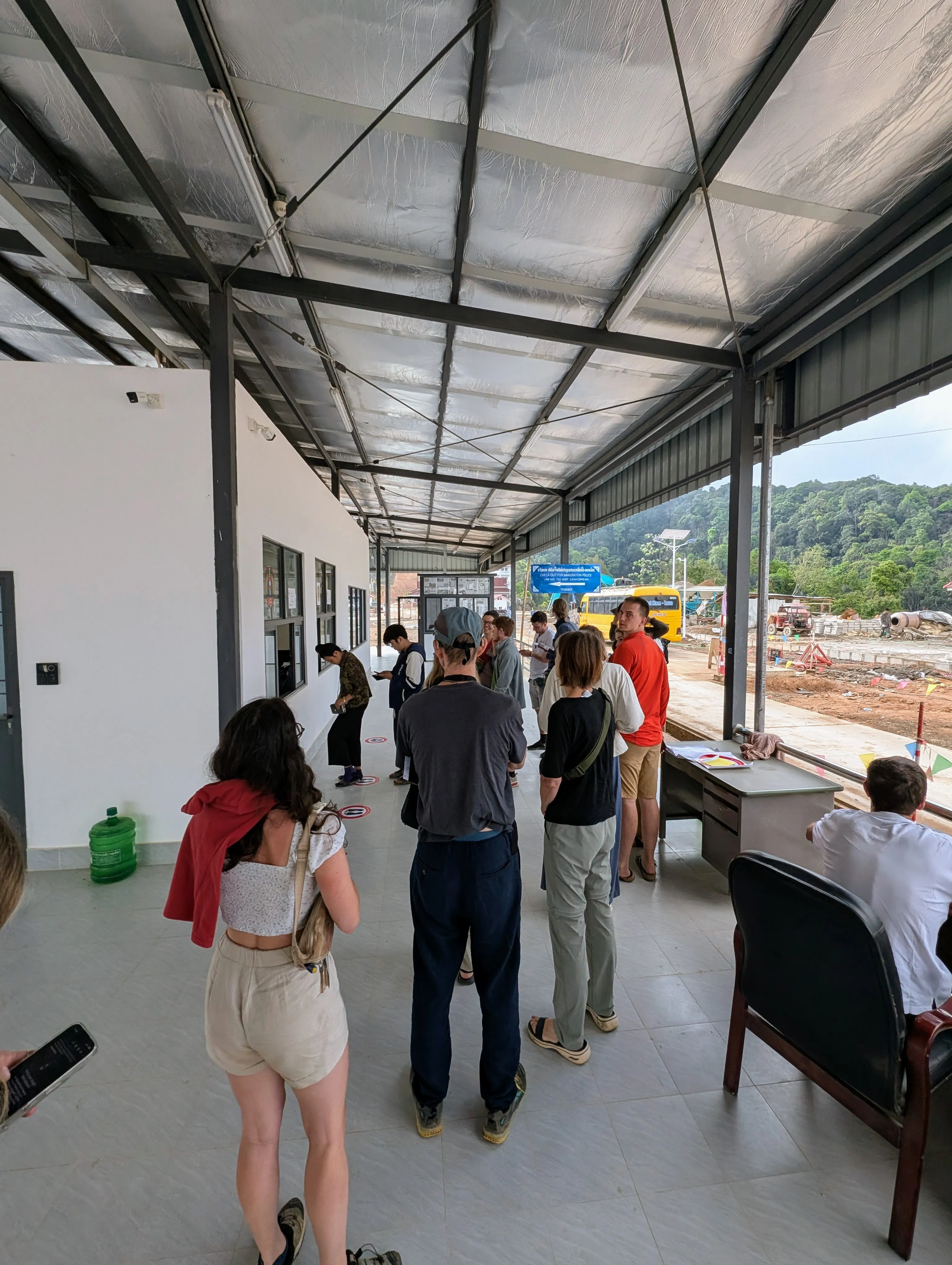 Leaving Laos.
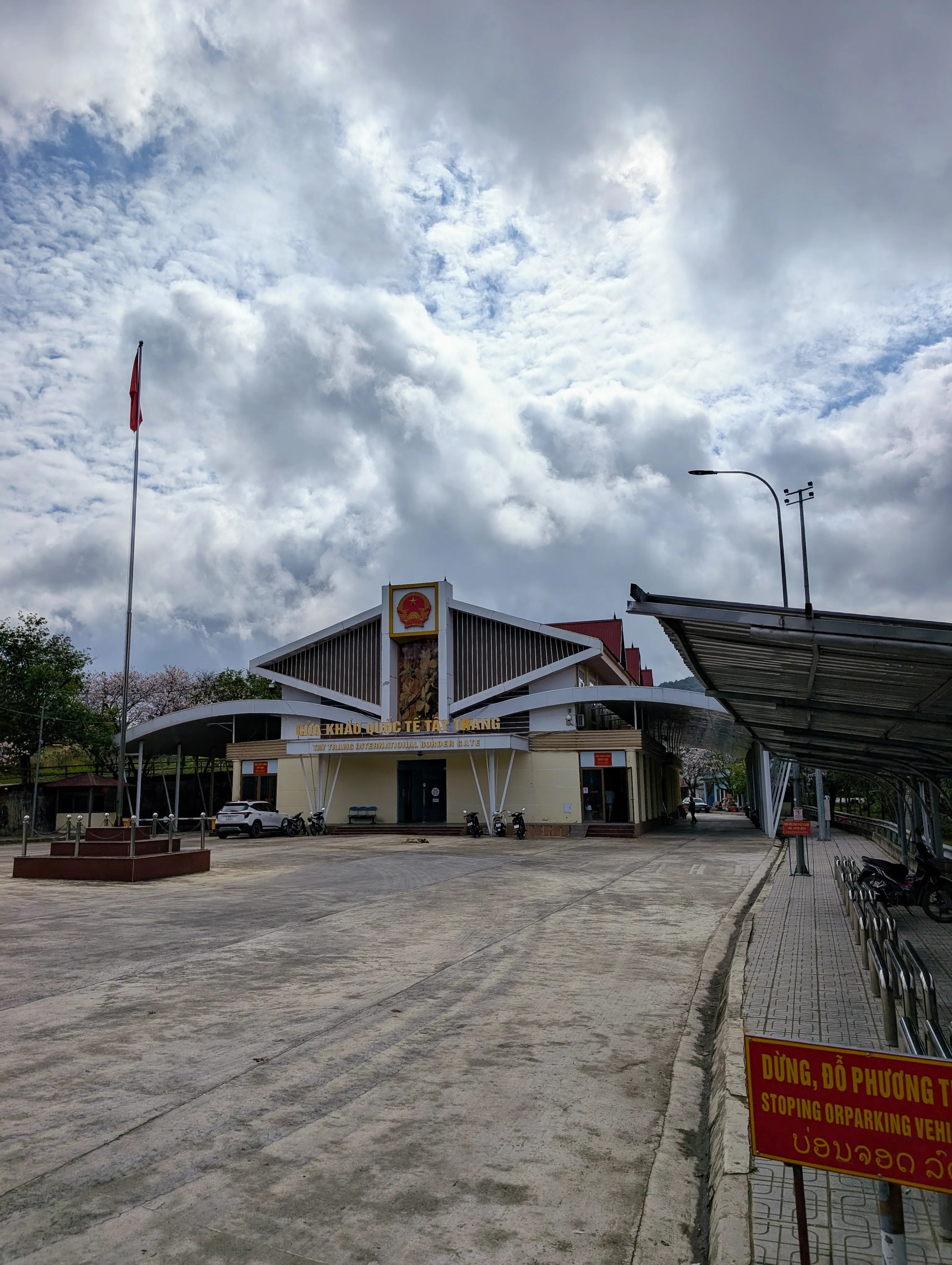 Entering Vietnam.
Điện Biên Phủ
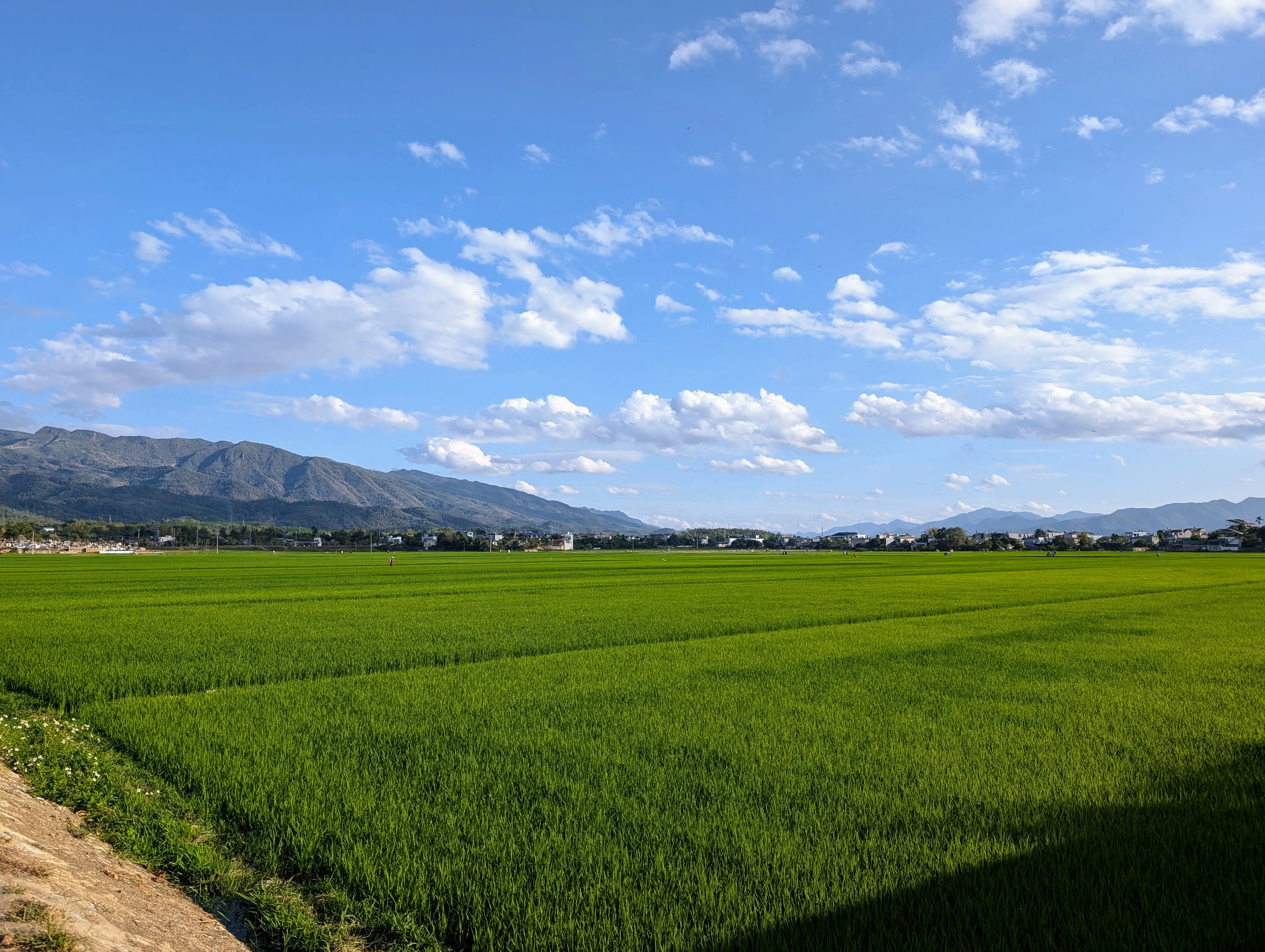 Rice paddies in Điện Biên Phủ.
This was the culmination of our overland journey from Thailand and a place I admit I did not know existed until this trip. However, it far exceeded our limited expectations and became a highlight of the entire route. Điện Biên Phủ is nestled in a pristine valley in far northwestern Vietnam, with rice paddies as far as the eye can see. In many ways the valley and surrounding hillsides reminded us of the Valley of the Moon in Sonoma, California near our hometown. Some travelers from the bus were immediately connecting onward to Sapa; Patrick, Natalia, Makeda and I opted to stay and slow down. Our guesthouse just outside town rented scooters, so the four of us set out to explore. With Tết just a couple weeks prior, the city was still draped in Vietnamese flags and celebratory banners, increasing the picturesque feeling of the city. Điện Biên Phủ is far enough off the beaten path that folks would often do double takes when we walked by, and children would eagerly shout and wave “Hello! Hello!” to us around town. Especially compared to Hanoi, the vibe was exceptionally chill - particularly when it came to traffic.
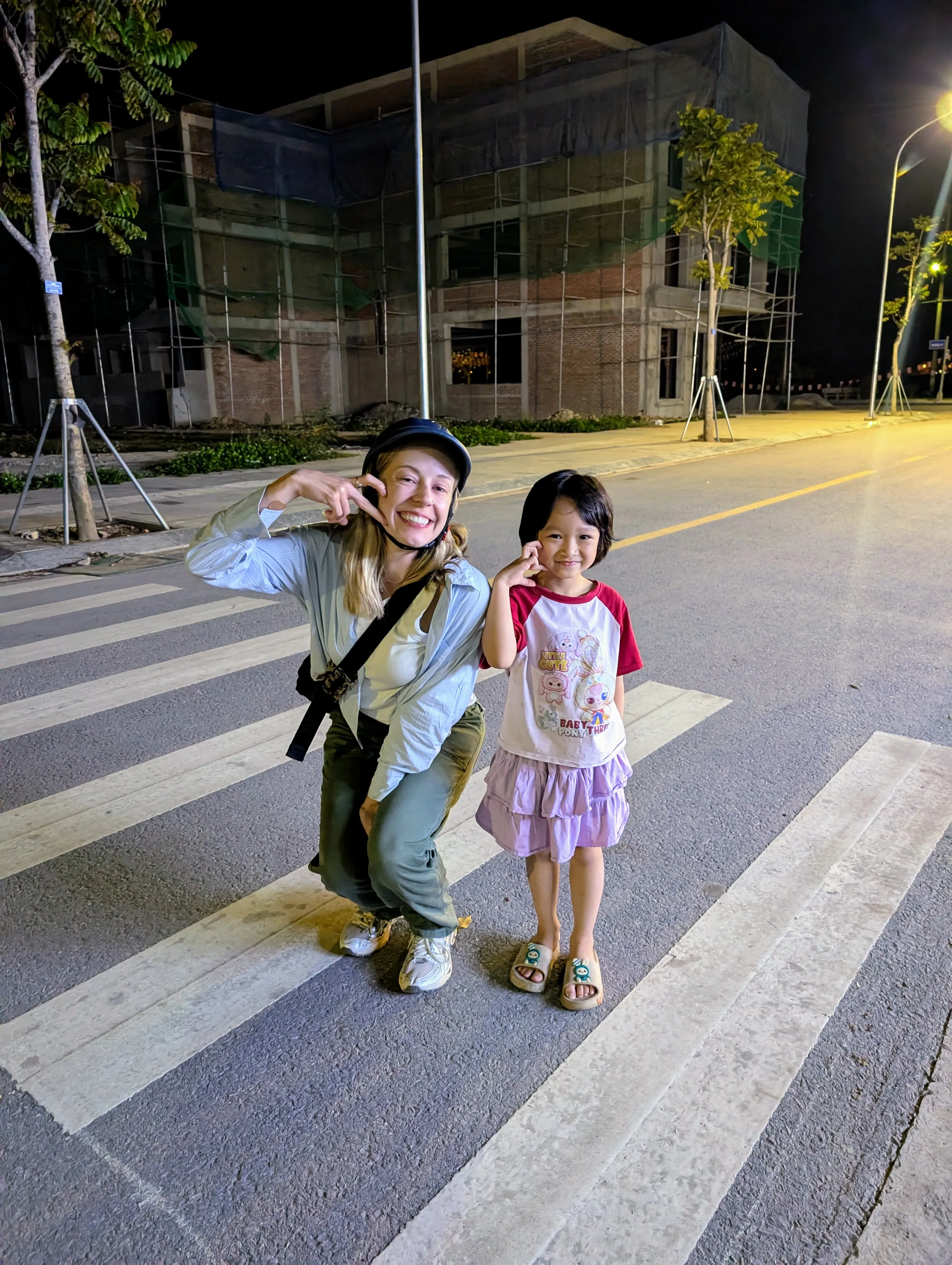 MJ with her new friend.
Điện Biên Phủ is of major historical importance in Vietnam. It is the site of the Battle of Điện Biên Phủ in which the Viet Minh decisively defeated the French in 1954 and effectively ended the First Indochina War and French colonial rule in northern Vietnam. We enjoyed learning about this history at the Victory Museum, but found the A1 Hill and Martyr’s Shrine to be fascinating and not to be missed. A1 is one of the strategic hills in the valley used by the French army during the battle. Its capture was essential to the Viet Minh’s victory. Today, it is a public park in the center of town with trenches, bunkers, and mortar craters still intact. The Martyr’s Shrine is adjacent to the hill and is a touching monument to the soldiers who died resisting colonial rule. The history of the city is well preserved, educational, and inspiring.
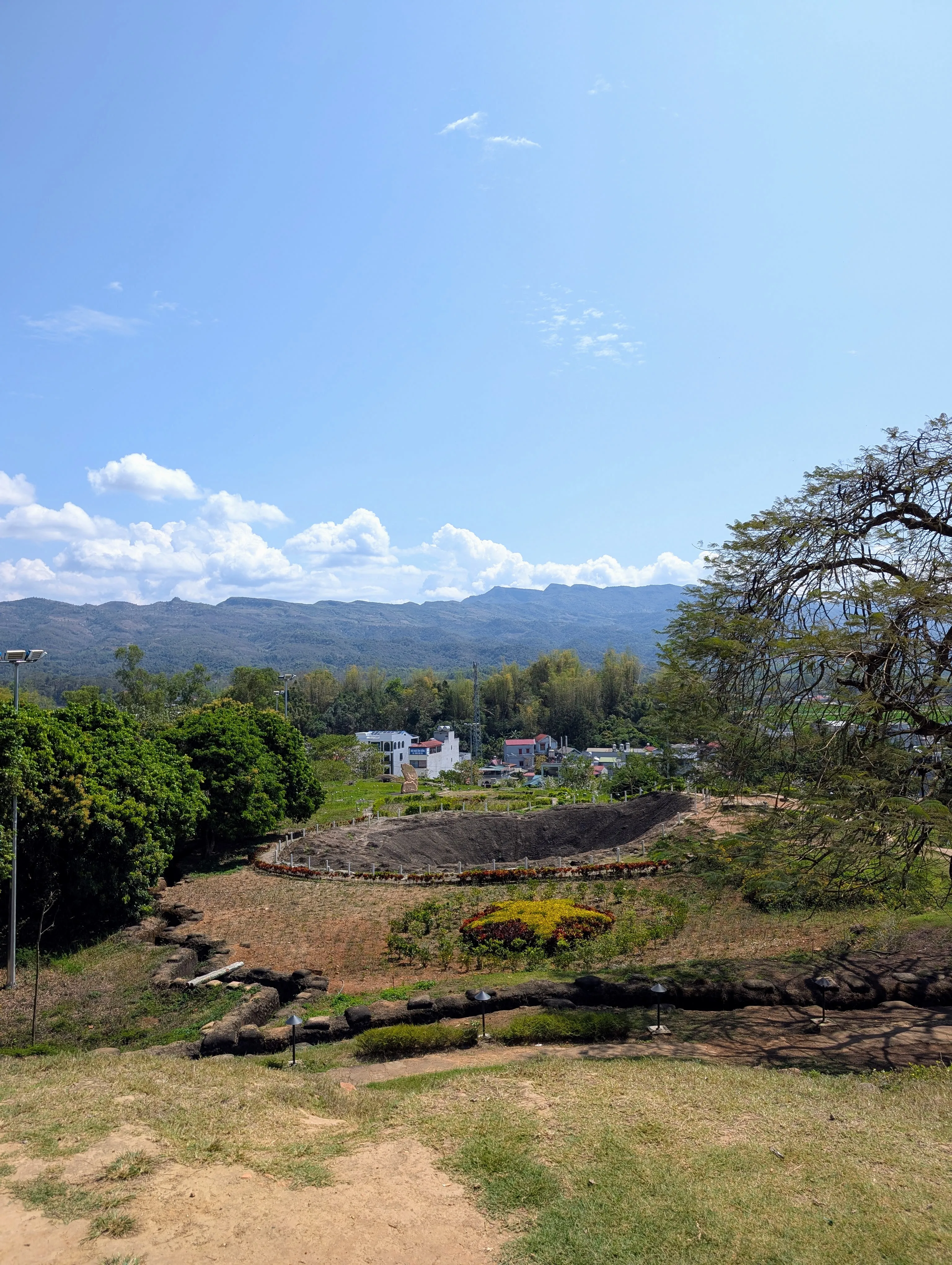 Trenches and a mortar crater on A1 Hill.
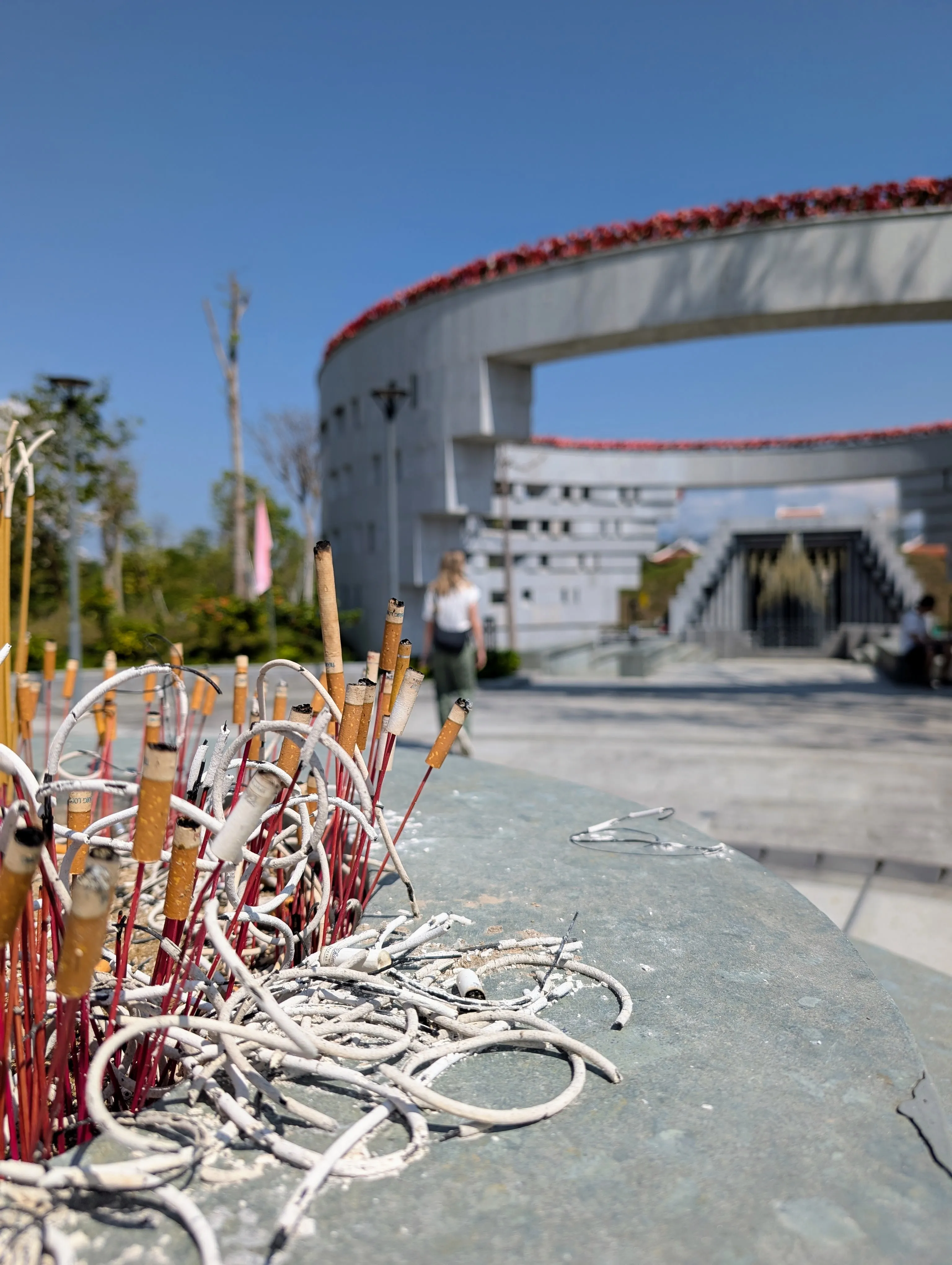 Offerings at the Martyr Shrine.
After visiting the A1 Hill, Makeda and I took the recommendation of some folks we met at lunch and drove our scooter up the eastern hills to a panoramic viewpoint. The first 90 percent of the drive was easy: gentle curves along open roads past rice terraces and homesteads. The final stretch was not. We had turned off the main road onto narrow country lanes that immediately kicked up to grades of 15 to 20 percent. Eventually we parked and finished the last mile on foot. The views were worth it.
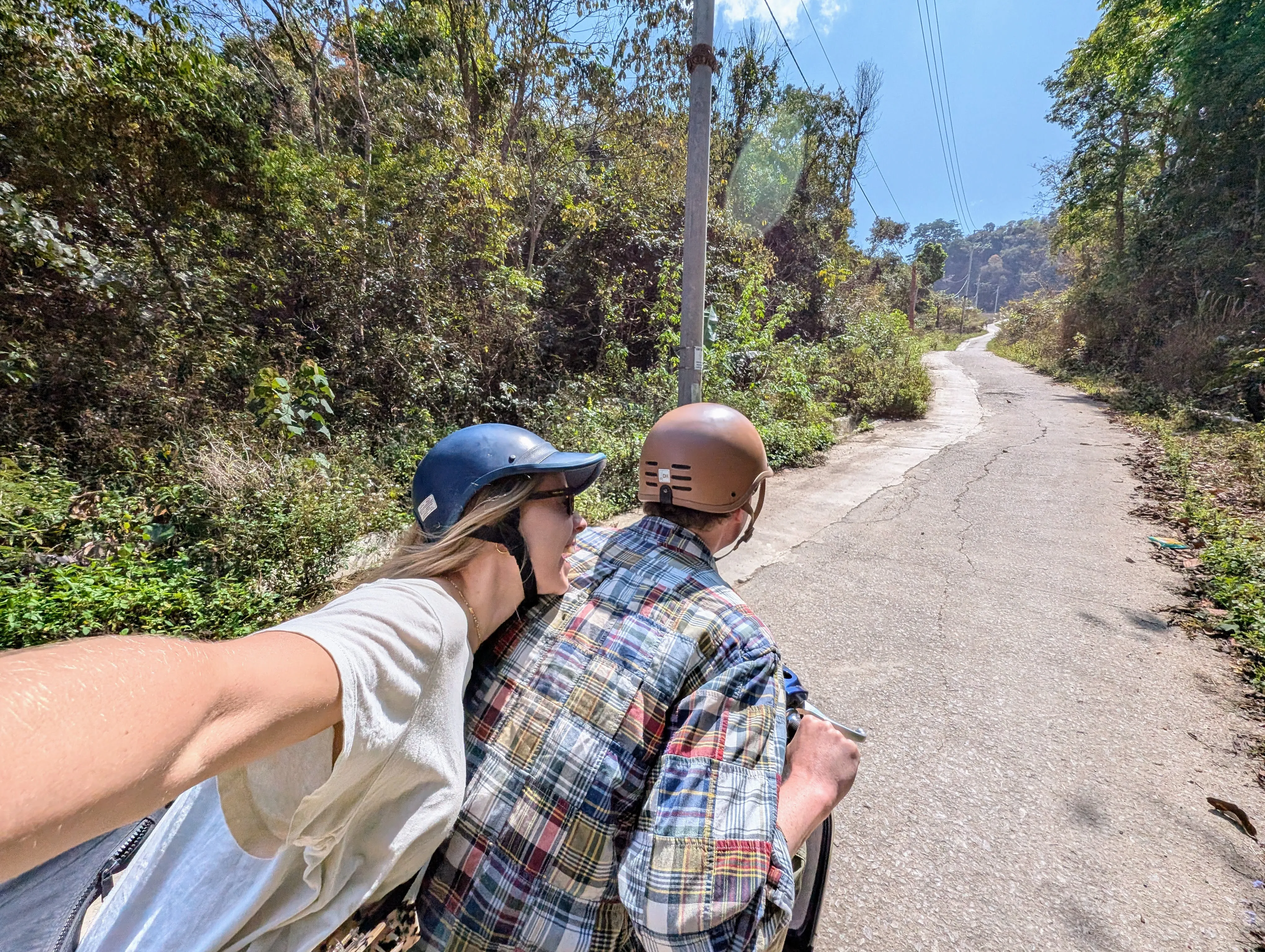 Lean forward!!
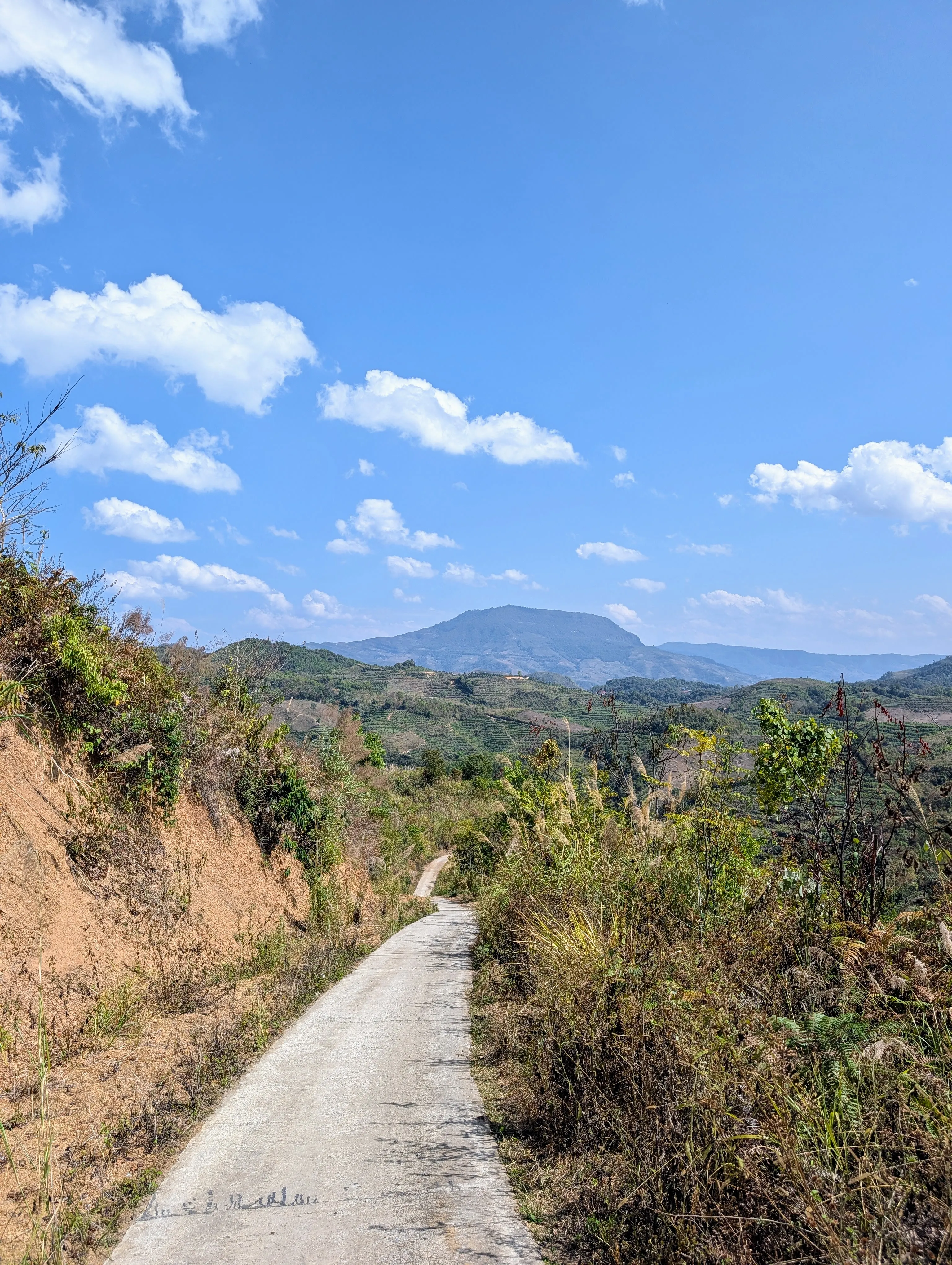 Hill country east of Điện Biên Phủ.
After two nights in the quiet mountain paradise of Điện Biên Phủ, we booked our flight to Hanoi, thus concluding our overland journey. Patrick and Natalia were staying longer, so we said our goodbyes and made our way to the airport. While waiting to board, we ran into a Dutch couple named Yegor and Iris that we had met on the bus over the border. We exchanged information and ended up having a fun night out together later in Hanoi. The journey was ending, but our luck with meeting other friendly travelers was not.
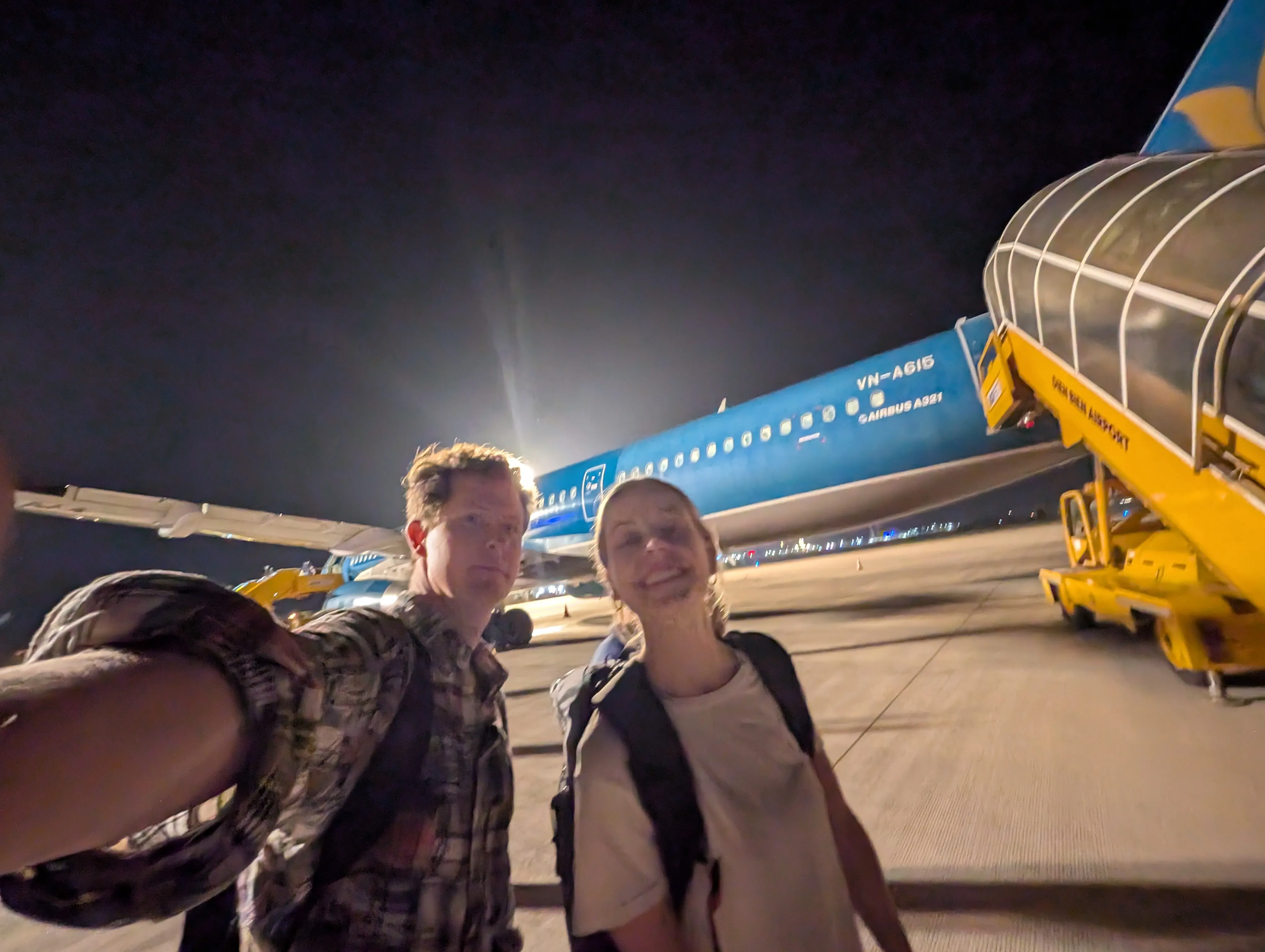 Boarding the plane in Điện Biên Phủ.
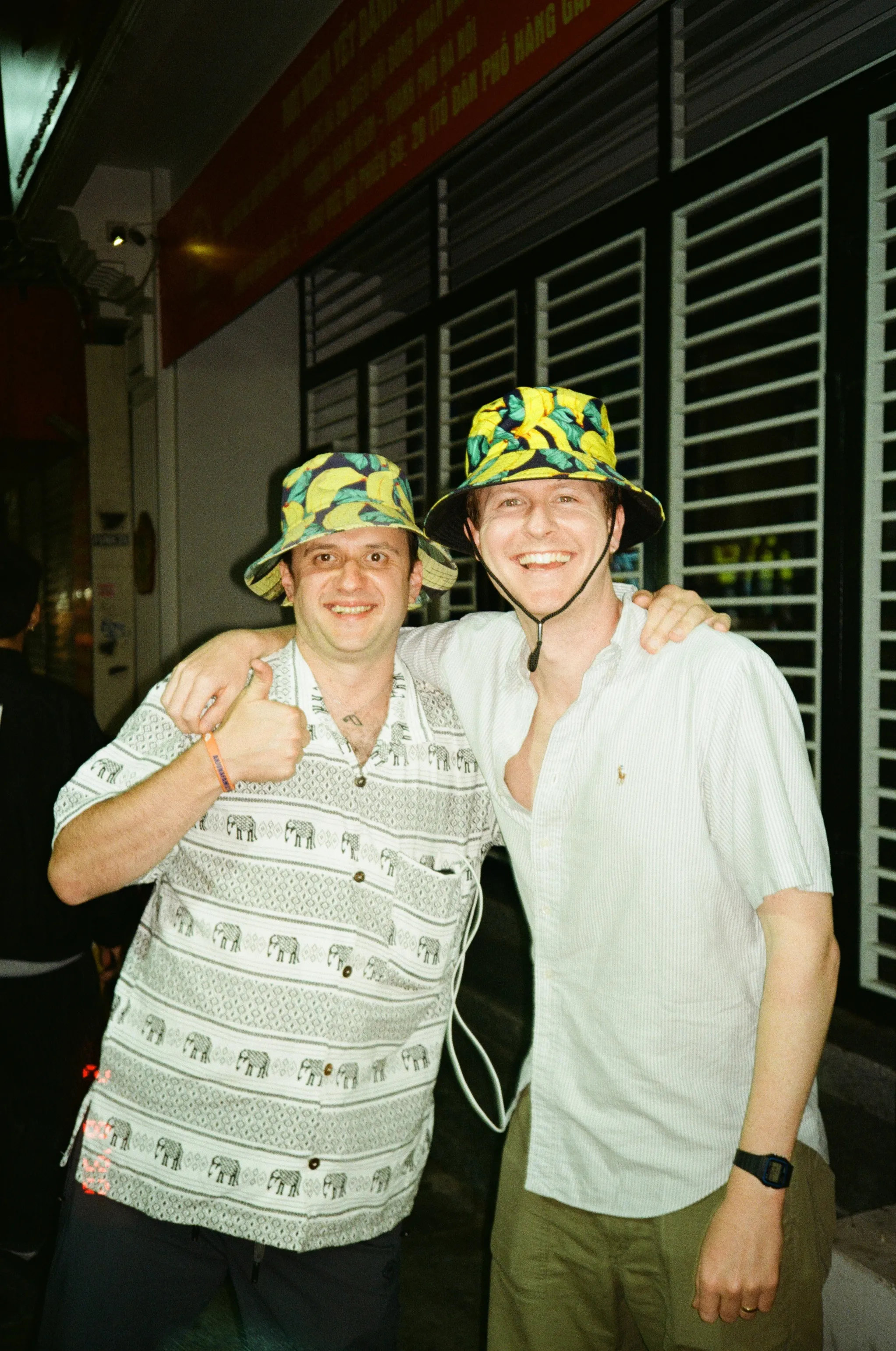 Yegor and I in Hanoi.
Conclusion
This journey was absolutely spectacular. We loved being able to sink briefly into a region and experience places otherwise unknown to us. Personally, working out the puzzle of each leg - each connection, each border crossing - was a ton of fun. There is something wonderful about looking at a map, sketching a route, and then making it happen day by day. But ultimately, it was the people we met along the way who made the trip unforgettable. Everyone was totally open to connection, willing to share knowledge and resources, and ready for whatever came next. We were all, quite literally, in the same boat.